

What if the most vital protector of your home's structural integrity is a piece of metal you've never actually noticed? A weep screed is the essential drainage system for your stucco. It's a specialized flashing installed at the base of your walls that allows moisture to exit safely before it rots your wooden frame.
It's stressful to see peeling paint or hairline cracks near your foundation and not know the cause. You care about the longevity of your home, but complex building codes often create more confusion than clarity. We believe in transparency and want to help you identify these hidden risks before they lead to mold or structural decay.
This guide will help you verify if your home meets the 2022 California Building Code, specifically the requirement for a 3.5-inch vertical flange and the mandatory 4-inch ground clearance. You'll learn how to spot signs of a failing system, such as a blocked drainage path or rusted metal. We'll also explain the professional repair process to ensure your stucco remains beautiful and bone-dry for years to come.
Key Takeaways
- Identify how a weep screed creates a necessary drainage path to prevent trapped moisture from rotting your home’s wooden frame.
- Compare the durability of galvanized steel, vinyl, and zinc alloy to choose the best protection for your specific local environment.
- Confirm your property complies with the "4-inch rule" and ASTM C1063 standards to avoid costly building code violations and water intrusion.
- Recognize physical red flags like stucco flaking or interior dampness that signal it's time for a professional moisture-management retrofit.
What is a Weep Screed and Why Does Stucco Need One?
Think of your home’s stucco as a protective shell that breathes. While it looks solid, it's actually a porous material that absorbs water like a sponge during heavy rain.
A weep screed is the essential perforated metal or vinyl flashing installed at the base of your framed walls. Unlike typical architectural screeds used to level floors, this component serves as a dedicated exit path for liquid.
Its primary job is to protect your wooden sill plate and foundation from moisture damage. Behind your stucco lies the Water Resistive Barrier (WRB), which acts as a secondary shield for your framing.
As water penetrates the stucco, the Water Resistive Barrier (WRB) catches it and sheds it downward. The screed provides the final opening for that water to escape the wall assembly before it can cause structural rot.
[Image: Labeled diagram showing a weep screed installation with the WRB and metal lath]The Anatomy of a Functional Weep Screed
A high-quality screed usually features a V-shape or J-shape profile. The long vertical flange sits behind the WRB to ensure water flows over the metal rather than behind it.
Small, precision-drilled drainage holes at the bottom allow moisture to "weep" out safely. We terminate the metal lath and the initial scratch coat into this flange, creating a clean, functional edge for the stucco system.
Consequences of a Missing or Blocked Screed
If your home lacks this component, or if it's buried under soil, a dangerous "pooling effect" begins. Moisture gets trapped against your wooden framing with no way to evaporate or drain.
This often leads to signs stucco needs repair, such as bubbling finishes or crumbling edges. Without a clear exit, the water will eventually find its way into your structure, causing expensive rot and mold growth.
Materials and Technical Specifications for Durability
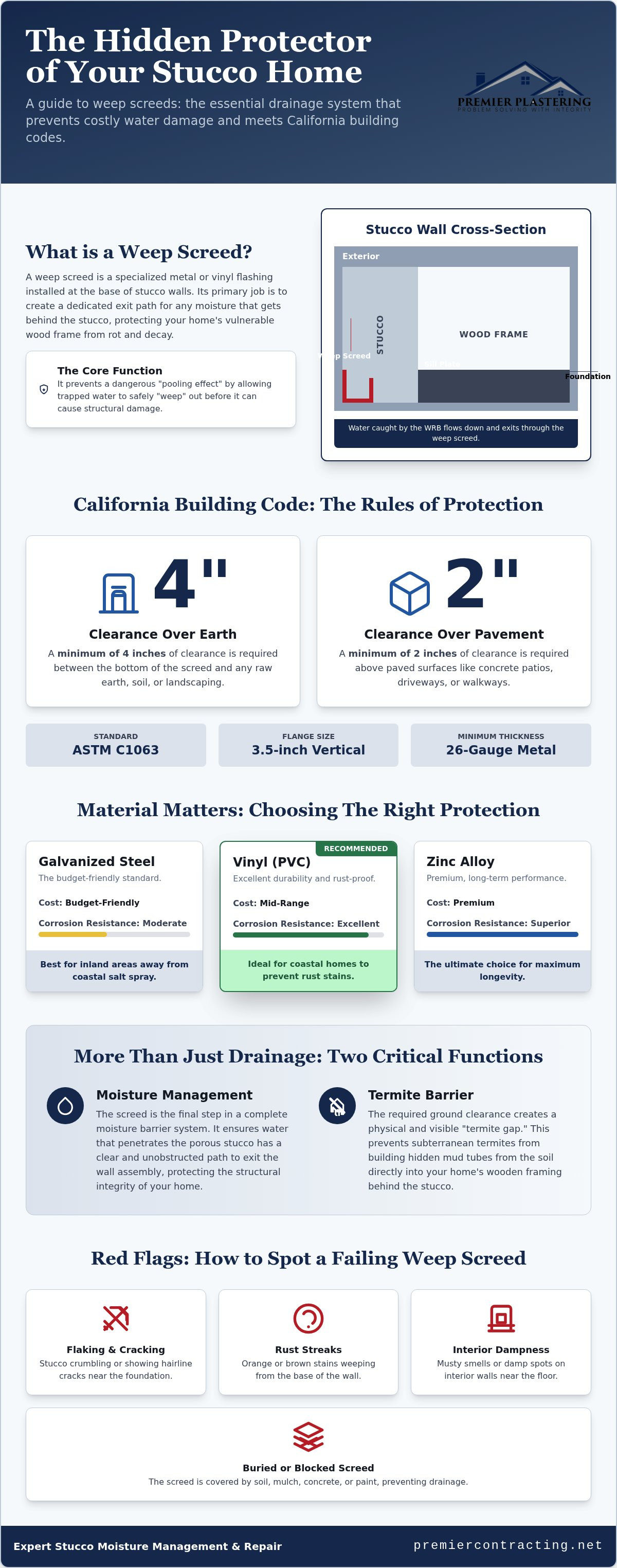
Selecting the right material for your weep screed is a decision that dictates the lifespan of your exterior. In Orange County, we prioritize durability because our coastal air is unforgiving. According to the California Residential Code R703.7.2.1, residential screeds must meet a minimum thickness of 0.019 inches, commonly known as 26-gauge. This weight provides the rigidity needed to support the heavy layers of a traditional three-coat stucco system without warping under the pressure.
Galvanized vs. Vinyl: Which is Right for SoCal?
For homes in inland Fullerton, galvanized steel often suffices. However, if you live in Huntington Beach or Newport, the salt spray will eat through standard metal within years.
| Feature | Galvanized Steel | Vinyl (PVC) | Zinc Alloy |
|---|---|---|---|
| Cost | Budget-Friendly | Mid-Range | Premium |
| Corrosion Resistance | Moderate | Excellent | Superior |
| Flexibility | Low | High | Moderate |
We strongly recommend Vinyl for high-moisture coastal environments. It never rusts, which prevents those unsightly orange streaks at the bottom of your walls. If you aren't sure which material your current system uses, our team can provide expert stucco services to evaluate your home's protection.
The Termite Barrier Function
Beyond moisture management, your screed serves a critical role in pest control. It creates a visible "termite gap" between the stucco and the soil. This prevents subterranean termites from building mud tubes into your wall cavity unnoticed. Without this gap, pests can tunnel directly from the earth into your framing behind the stucco. Many Orange County inspectors look for this specific clearance to ensure the home remains defensible against infestation.
Installation Standards and California Building Codes
Proper installation isn't just about aesthetics; it's about following the California Building Code Weep Screed Requirements to prevent structural failure. Professional contractors follow ASTM C1063, which mandates specific clearances to stop water from "wicking" back into your walls. You must maintain at least 4 inches of clearance above raw earth or soil and 2 inches above paved surfaces like patios or sidewalks.
Burying your weep screed with mulch, dirt, or concrete is a recipe for disaster. When the drainage holes are covered, moisture can't escape. Instead, the stucco acts like a straw, pulling groundwater upward into your wooden framing. This leads to the "pooling effect" we discussed earlier, rotting your sill plates from the inside out.
The Professional Installation Framework
In addition to maintaining clearance, it is vital to ensure that surrounding concrete surfaces slope away from the foundation. If a sunken patio or walkway is directing water toward your walls, RiseLock Concrete Lifting provides polyurethane leveling to restore the proper grade and protect your home's structural integrity.
We follow a methodical three-step process to ensure your drainage system works exactly as intended:
- Step 1: We begin by chalking a perfectly level line across the foundation plate to ensure uniform drainage across the entire perimeter.
- Step 2: Our team laps the Water Resistive Barrier (WRB) over the screed’s attachment flange to create a "shingle-lap" that directs water outward.
- Step 3: We secure the flashing with corrosion-resistant fasteners every 6 to 12 inches to prevent the metal from pulling away during the scratch coat application.
Local Fullerton Inspections: What to Expect
In Orange County, city inspectors require the screed to be fully visible during a lath inspection. If you're hiring a stucco contractor in Fullerton, they must ensure this clearance is maintained before any plaster is applied. Common code violations in older homes often involve screeds that were installed too low or were later covered by new landscaping projects.
If you're worried your current stucco isn't up to code, contact us for professional stucco patching and repair to restore your home's protection.
Diagnosing and Repairing Weep Screed Failure
You can often spot a failing weep screed by looking for heavy rusting or "bleeding" along the foundation line. If you see stucco flaking at the bottom or feel dampness on your interior baseboards, moisture is likely already trapped. Never attempt to "fix" these gaps by caulking the holes shut. This common DIY mistake seals water inside your walls and accelerates wood rot. While these components handle drainage from within the wall assembly, protecting your home against external rising water is also essential; FloodWater Pros specializes in flood barrier systems that complement your home's moisture defenses.
The Repair Process: From Demolition to Finish
A proper retrofit requires a methodical approach to protect your home's skeleton. We carefully cut back the bottom 6 to 12 inches of stucco to expose the foundation plate without damaging the underlying structure. Once the old, compromised metal is removed, we install a new, corrosion-resistant screed and integrate it with the existing moisture barrier.
Achieving a seamless look after this invasive work requires specialized residential stucco repair. Our team focuses on precise color and texture matching so the repair area vanishes into your original wall. Following the installation, we perform a detailed stucco crack repair to ensure the entire system is watertight and visually consistent.
Maintenance Tips for Homeowners
Maintaining your home's drainage is simple but vital for longevity. Keep dirt, mulch, and landscaping debris cleared away from the base of your walls to ensure the holes stay open. After your home is painted, check the bottom edge to ensure the painters didn't accidentally clog the drainage path with thick coatings.
Consistent care prevents minor moisture issues from becoming structural nightmares. If you notice any red flags or visible rust, Contact Premier Plastering for a professional stucco inspection to protect your investment and restore your peace of mind.
Securing Your Home’s Future with Proper Drainage
Your home’s exterior is only as strong as its ability to shed water. A functional weep screed is the difference between a dry foundation and a structural nightmare. By ensuring your installation follows the 4-inch ground clearance rule and uses corrosion-resistant materials, you protect your wooden framing from invisible rot. Staying proactive about maintenance ensures your stucco system performs exactly as designed for decades.
We’ve served Fullerton and Orange County for over a decade as licensed and insured master craftsmen. Our team specializes in seamless texture matching, so any necessary repairs blend perfectly with your existing finish. Don’t let hidden moisture compromise your investment or your peace of mind. Protect your home’s foundation with an expert stucco inspection from Premier Plastering. We’re here to help you maintain a beautiful, resilient home that stands the test of time.
Common Questions About Stucco Drainage
Can I paint over my weep screed holes?
You must never paint over or seal the drainage holes in your weep screed. These small openings are the only exit path for moisture that penetrates your stucco finish. If you clog them with thick exterior paint or caulk, water becomes trapped against your home's wooden frame. This leads to rapid wood rot and mold growth that often requires expensive structural repairs to resolve.
Why is there a gap between my stucco and the ground?
That gap is a deliberate design feature required by the California Building Code to protect your foundation. It ensures the drainage system can breathe and prevents the stucco from "wicking" groundwater up into your walls. In Fullerton and surrounding Orange County cities, this gap also serves as a critical termite barrier. It allows you to spot mud tubes before pests enter your wall cavity.
How do I know if my weep screed is installed correctly?
A correct installation is clearly visible and sits at the proper height above the ground. You should see at least 4 inches of clearance from raw soil or 2 inches from paved surfaces like your driveway. The metal or vinyl flange must be straight and free of debris. If your landscaping has buried the bottom of your stucco, your system is failing and needs professional adjustment.
What happens if my weep screed is rusted out?
A rusted screed often indicates that water is pooling at the base of your wall rather than draining away. As the metal corrodes, it loses its structural integrity and can no longer support the weight of the stucco above it. This often causes the bottom edge of your wall to flake or crumble. We recommend a professional inspection to determine if a full retrofit is necessary to prevent rot.
Does every stucco house have a weep screed?
No, homes built before 1970 often lack this critical drainage component because it wasn't yet mandated by building codes. These older properties are at a much higher risk for hidden water damage and foundation rot. If you own a vintage home in Anaheim or Santa Ana, we can install a modern weep screed during a restoration project to bring your exterior up to current safety standards.


