

An authentic italian plaster finish is not just a decorative coating; it's a living, breathable mineral skin that actually improves with age. While standard paint eventually peels or fades, these lime-based materials undergo a natural chemical process to turn back into stone on your walls. This unique composition ensures your home's interior remains as durable as it is beautiful.
You want a home that reflects a deep sense of heritage and luxury, but you might worry about durability in high-traffic areas or finding a local artisan who truly understands these ancient techniques. This guide clarifies the material science and aesthetic versatility of authentic plaster to help you make an informed investment for your interior. We'll examine why lime is naturally mold-resistant and how it contributes to a healthier, low-VOC indoor environment.
We'll break down the differences between polished and rustic textures while providing clear criteria for selecting a reliable contractor in Fullerton or Anaheim. You'll discover how to transform your space into a sanctuary of Old World texture that stands the test of time. Understanding these distinctions is the first step toward achieving a professional, high-end result.
Key Takeaways
- Learn how the chemical process of carbonatization transforms lime and marble dust into a permanent stone surface on your walls.
- Discover how to select the perfect italian plaster finish by comparing the visual impact of high-gloss polished surfaces against rustic, stone-like textures.
- Understand the health benefits of breathable, high-pH lime plaster that naturally inhibits mold growth in Southern California's humid coastal environments.
- Identify the critical steps in the professional application process, from substrate preparation to final waxing, to ensure a seamless and durable result.
What is an Italian Plaster Finish? Composition and Heritage
An authentic italian plaster finish is a specialized wall covering made from aged lime putty, ground marble dust, and mineral pigments. Unlike standard paint, it is a multi-layered, hand-applied finish that creates a sense of depth and organic movement that synthetic coatings cannot replicate. It belongs to a category of finishes often called Polished Plaster, which encompasses various traditional techniques used for centuries.
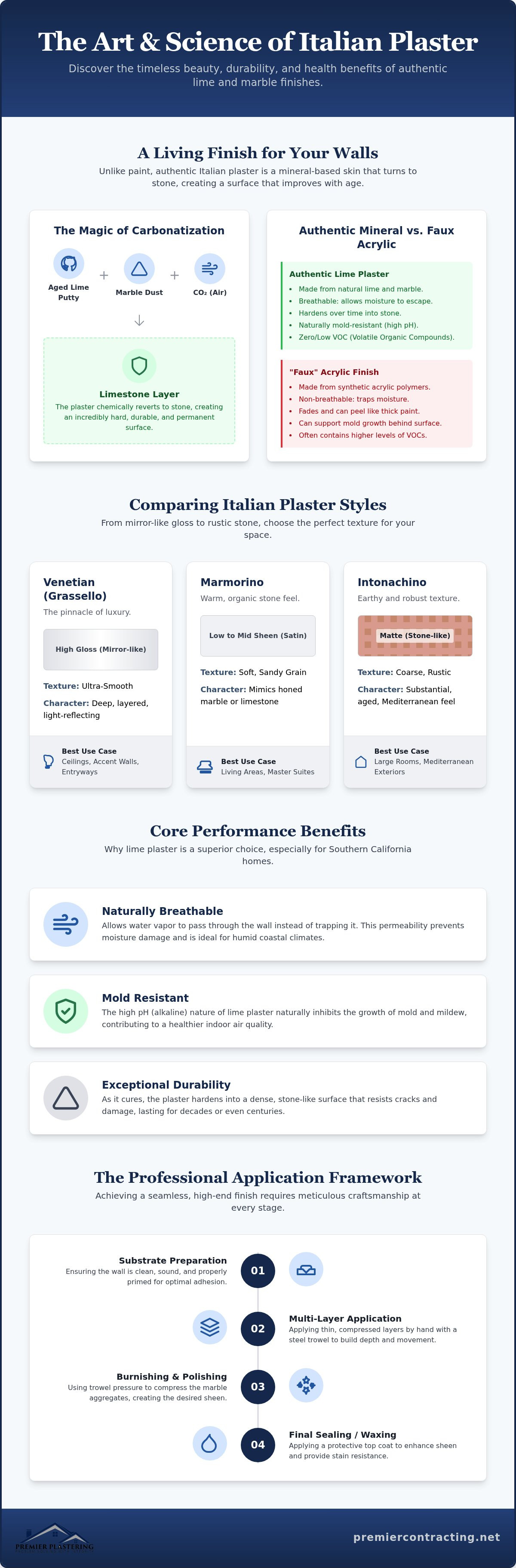
The true magic lies in a chemical process called carbonatization. As the wet lime absorbs carbon dioxide from the air, it chemically reverts to limestone. Your walls aren't just covered in color; they are encased in a thin layer of actual stone that hardens over time. Don't confuse this with "faux" acrylic finishes sold in big-box stores. Those are essentially thick, plastic-based paints that lack the breathability and longevity of true mineral plaster.
The Core Ingredients: Lime and Marble
Slaked lime serves as the natural binder for the mixture. It remains soft during application but gains incredible structural integrity as it cures. We mix this with marble aggregates of varying sizes to provide the finish with its signature shimmer and stone-like density. These natural minerals allow the wall to breathe, which prevents moisture from being trapped behind the surface.
Why Artisanal Application Matters
The final aesthetic isn't just in the bucket; it's in the craftsman's hands. We create the unique texture and sheen through precise trowel pressure and burnishing. Principled craftsmanship ensures that every layer is applied with consistency and care. A skilled artisan manages the "movement" of the italian plaster finish, making sure the result looks intentional and high-end rather than repetitive or messy. This level of detail provides an ideal backdrop for showcasing rare and high-quality antique furniture, such as the pieces found at nwtiques.com.
Selecting an italian plaster finish requires balancing your personal taste with the architectural style of your home. The way light hits a mirror-polished surface differs significantly from how it settles on a rustic, matte texture. Use the table below to compare the technical specifications and ideal uses for the most common traditional styles.
| Style | Sheen Level | Texture | Best Use Case |
|---|---|---|---|
| Venetian (Grassello) | High Gloss (Mirror-like) | Ultra-Smooth | Ceilings, Accent Walls, Entryways |
| Marmorino | Low to Mid Sheen (Satin) | Soft, Sandy Grain | Living Areas, Master Suites |
| Intonachino | Matte (Stone-like) | Coarse, Rustic | Large Open Rooms, Mediterranean Exteriors |
Polished Venetian Plaster (Grassello)
Venetian plaster represents the pinnacle of luxury for formal spaces. We achieve this high-gloss finish by applying ultra-fine marble dust in paper-thin layers and burnishing the surface with a steel trowel. It's a popular choice for ceilings and entryways in Fullerton where you want to maximize natural light reflection.
Textured Marmorino and Rustic Finishes
Marmorino offers a more subtle, satin glow that mimics the look of natural stone or honed marble. This medium-grain texture hides minor wall imperfections better than polished styles and provides a warm, organic feel. It perfectly complements the Mediterranean architecture common in Yorba Linda and Anaheim Hills.
Understanding the History of Lime Plaster helps you appreciate why these textures have endured for centuries. If you're still weighing your choices, our team can show you physical samples of various Venetian plastering options to see how they look in your specific lighting. This hands-on approach ensures your final italian plaster finish feels intentional and balanced.
Performance Benefits for Southern California Homes
Living near the coast in Huntington Beach or the humid pockets of Fullerton requires materials that handle moisture effectively. An italian plaster finish is naturally breathable, meaning it allows water vapor to pass through the wall instead of trapping it behind a layer of paint.
This permeability is a core feature of traditional Italian plaster finishes. Because the material is highly alkaline with a high pH level, it acts as a natural fungicide. It prevents mold and mildew from taking hold in your home.
Unlike standard paint that eventually peels or flakes, this finish is a permanent part of the substrate. You can see a similar longevity in our how long does stucco last analysis. This durability makes it a superior choice for high-end residential interiors.
Eco-Friendly and VOC-Free Living
These mineral plasters are composed of natural earth elements, making them completely VOC-free. This ensures your indoor air quality remains pristine for your family. It's a "healthier home" solution that aligns with the wellness-focused lifestyle common in Orange County and surrounding cities.
Durability and Value Appreciation
Investing in an italian plaster finish adds tangible resale value to your property. While you might face a 5-7 year cycle for residential stucco repair on the exterior, interior plaster remains an enduring architectural feature. It transforms a simple wall into a piece of art that appeals to high-end buyers.
It's a one-time application that eliminates the need for frequent repainting. This long-term ROI makes it a smarter financial choice than temporary decorative fixes. Ready to upgrade your interior? Contact us for expert Venetian plastering services today.
The Professional Application Framework and Long-Term Care
Achieving a stone-hard italian plaster finish requires more than just high-quality materials; it demands a disciplined, multi-stage application protocol. This framework ensures that the mineral layers bond correctly to the substrate for a lifetime of durability. Every project follows a specific sequence to guarantee structural integrity and visual depth.
- Substrate Preparation: We apply a specialized mineral primer to create a "key" for the plaster to grip.
- Base Layer Application: Two coats of lime plaster build the necessary foundation and structural thickness.
- Artisanal Finish Coats: We apply thin final layers and use trowel pressure to create the desired texture or sheen.
- Burnishing and Waxing: For high-gloss or high-moisture areas, we burnish the surface and apply a protective natural sealer.
This commitment to precision is essential for any high-end home renovation. To see how professional standards are applied to broader home improvements, you can discover 1st Class Painting & Restoration, which offers expert painting and remodeling services in the Charleston area.
A master craftsman ensures that every layer is applied with consistent pressure to avoid visible seams in large, open-concept rooms. This attention to detail is critical for texture matching and creating a unified look across multiple walls. While the cured finish is incredibly hard, it remains repairable if a skilled artisan handles the patching process.
Maintenance and Cleaning Tips
To preserve the organic glow of your walls, follow simple care standards rather than using harsh chemicals. Use only mild soap and distilled water for routine cleaning or spot removal. You'll want to avoid abrasive sponges that can etch the lime surface or strip away the protective wax barrier.
Refresh the protective barrier with a light re-waxing every 3 to 5 years in high-traffic zones. This maintenance step restores the original depth of the italian plaster finish and maintains its water-resistant properties. It's an easy way to keep your architectural investment looking pristine for decades.
Why Professional Installation is Essential
DIY attempts often fail because the artisan must manage "wet edges" to prevent visible lap marks. Without expert timing and specialized tools, the plaster dries unevenly, leading to poor adhesion or inconsistent color. This is especially challenging in the dry Southern California heat, where the material sets quickly.
For specific project examples in our local area, read our guide on Venetian Plastering Fullerton. Our master craftsmen ensure every transition in your home is seamless and structurally sound. We prioritize a clean workspace and a finished product that exceeds artisanal standards.
Elevate Your Interior with Timeless Mineral Artistry
An authentic italian plaster finish is much more than a decorative choice; it's an investment in your home's long-term health and architectural character. You now understand how these lime-based surfaces naturally regulate moisture in our Southern California climate and harden into a permanent stone skin. Whether you choose a high-gloss polished look or a rustic, textured surface, the result is a breathable environment that improves with age. The success of these installations depends entirely on the steady hand and principled approach of a seasoned artisan.
As a family-owned business based in Fullerton, our master craftsman-led team treats every project with a deep sense of personal accountability. We specialize in luxury mineral finishes that provide a depth of movement and durability standard paint simply cannot match. Embrace a finish that adds lasting property value instead of temporary coatings. If you're ready to transform your space into a sanctuary of Old World texture, we're here to help.
Request a Consultation for Your Custom Italian Plaster Project today to see how we bring your vision to life with integrity and skill.
Expert Answers for Your Plastering Projects
Is Italian plaster the same as Venetian plaster?
Venetian plaster is a specific type of italian plaster finish known for its high-gloss, mirror-like appearance. While "Italian plaster" serves as a broad umbrella term for various lime-based mineral coatings, Venetian refers to the finest grain style. In our Fullerton and Anaheim projects, we help homeowners choose between these polished options and more rustic textures like Marmorino. Both styles share the same traditional heritage of lime and marble dust.
Can Italian plaster be used in bathrooms or high-moisture areas?
You can certainly use these finishes in bathrooms because they are naturally breathable and resist mold growth. However, they are not suitable for direct water contact like the inside of a shower. For homes in Yorba Linda or Anaheim Hills, we apply a protective wax coating to the surface. This barrier handles high humidity and occasional splashes without compromising the integrity of the artisanal mineral layers.
How do you clean Italian plaster walls without damaging the finish?
The best way to maintain your walls is with a soft microfiber cloth and a mild, pH-neutral soap solution. Don't use abrasive chemicals, bleach, or vinegar, as these can etch the natural lime and marble surface. If your Huntington Beach home has waxed walls, you can easily buff out light scuffs with a clean cloth. Regular dusting keeps the finish vibrant and prevents environmental debris from dulling the sheen.
Does Italian plaster crack easily in Southern California's climate?
Authentic plaster is quite durable, but it relies on a stable foundation to remain crack-free. While the material handles thermal expansion well, significant settling or seismic activity in Orange County can lead to hairline fractures. We prevent this by using fiberglass mesh and specialized primers during the substrate preparation phase. This disciplined process ensures your italian plaster finish remains beautiful despite the local temperature swings and environmental shifts.
Can I apply Italian plaster over existing painted drywall?
Yes, we frequently apply these finishes over existing drywall during renovations in Santa Ana and Villa Park. The key is using a high-quality mineral bonding primer that creates a rough texture for the plaster to adhere to. We first inspect the walls for any moisture damage or loose paint. Once the surface is stable and primed, the plaster bonds chemically to the wall for a lifetime of performance.


