

That thin, jagged line running across your home's exterior is rarely just a cosmetic blemish; it's often a silent warning from the structure itself. Most homeowners feel a sinking sense of dread when they spot new damage, worrying that a small fissure today will lead to a costly water intrusion crisis tomorrow. It's frustrating to watch a previous stucco crack repair fail or stand out like a sore thumb against your home's unique texture. You deserve a home that feels as solid as it looks.
This guide provides the clarity you need to address these issues with the precision of a master craftsman. You'll learn how to identify the root causes of damage and execute a restoration that's both structurally sound and aesthetically invisible. We'll walk through professional assessment techniques, the latest ASTM standards for restoration, and the specific preventative measures that keep your Orange County home resilient against the elements for decades. By the end, you'll have the confidence to protect your investment with integrity and care.
Key Takeaways
- Learn to distinguish between superficial hairline fractures and deep structural failures that threaten your home’s building envelope.
- Understand why a professional stucco crack repair requires proper "keying" and a thorough inspection of the underlying weather-resistive barrier.
- Avoid the common pitfall of using unbreathable sealants, which often trap moisture and lead to hidden decay within your walls.
- Discover how simple, disciplined maintenance like proper drainage and gentle washing protects your stucco’s longevity and curb appeal.
Understanding Stucco Cracks: Diagnosis and Severity
Diagnosis is the first step in any meaningful restoration. Before jumping into a stucco crack repair, you have to understand the wall's story. If you're new to the material, you might wonder, What is Stucco? Essentially, it's a rigid, cement-based shell designed to protect your home. Because it's so rigid, it doesn't always play well with the natural movement of a house. It's a traditional material that requires a thoughtful approach to maintain its integrity.
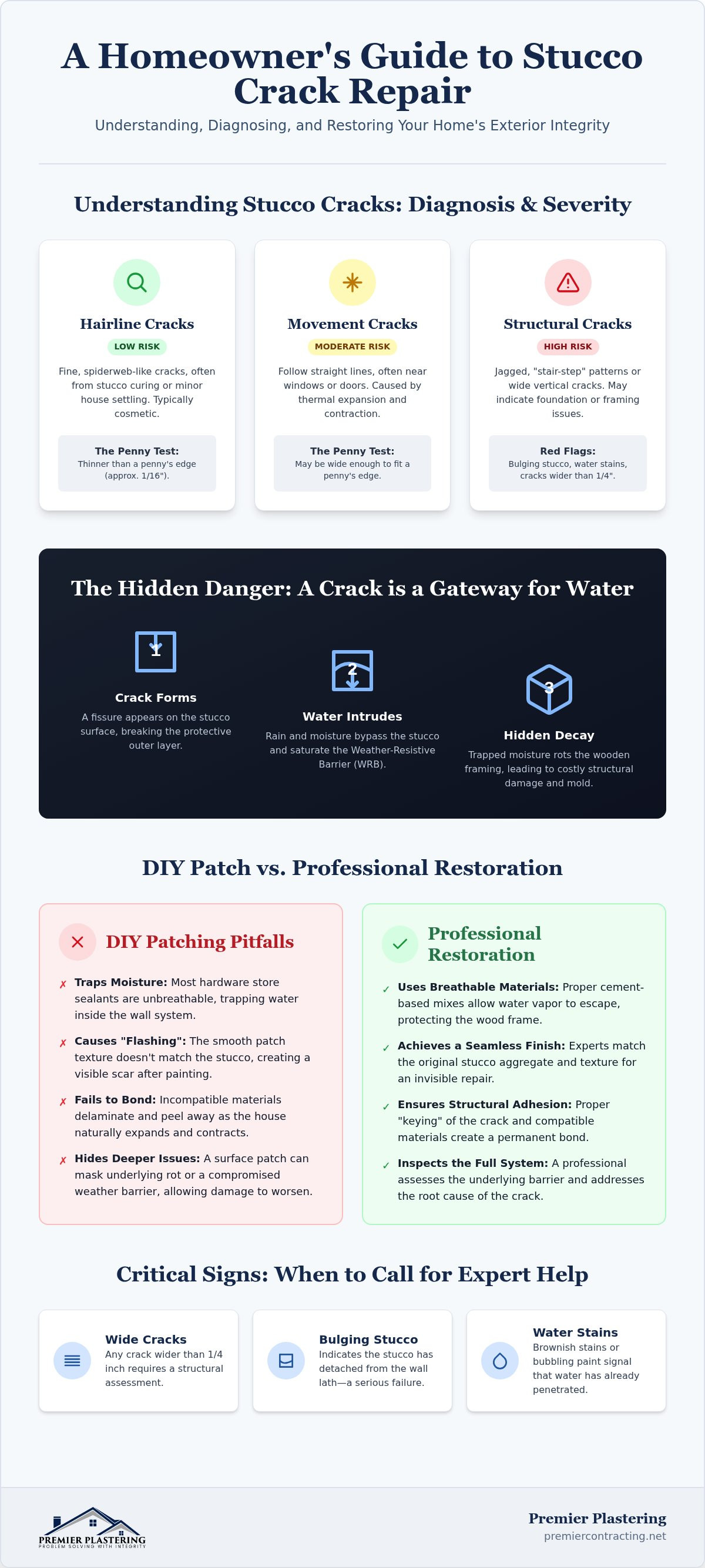
Most cracks fall into three categories: shrinkage, seasonal movement, and structural failure. To gauge the risk, use the "Penny Test." If a crack is thinner than a penny, roughly 1/16th of an inch, it's likely a surface issue. If you can fit the edge of a penny inside, or if the crack is wide enough to see the metal lath underneath, the weather-resistive barrier is compromised. This is where you'll often find signs of water intrusion, such as brown staining or bubbling paint, which suggest the wood framing is already under threat from rot.
Hairline vs. Structural: When to Worry
Spiderweb cracks are common. They usually happen during the curing process or as the house settles into its foundation. These are generally aesthetic concerns, though they still require attention to prevent moisture from seeping in. The real red flags are vertical or diagonal "staircase" cracks. These patterns often follow the lines of your home's framing or foundation. If you map these cracks and notice they're widening over time, it's a sign of significant stress. Performing a stucco crack repair on a moving foundation is like putting a bandage on a broken bone; you have to stabilize the structure first. For homeowners navigating these deeper structural issues, specialists like Foundation Werks offer helpful insights and financing solutions to ensure the home's primary support is sound before focusing on exterior aesthetics.
Environmental Stressors in Orange County
Our local environment is particularly hard on exterior finishes. Southern California is a land of seismic settling. Even small, imperceptible tremors can cause a rigid stucco system to snap. In Fullerton and Yorba Linda, we also deal with the Santa Ana winds. These dry, hot gusts cause rapid thermal expansion and contraction. This material fatigue eventually leads to fissures. Coastal humidity can soften the substrate over decades, while inland heat accelerates the drying of patches. Understanding these microclimates is why a local, artisanal approach is so vital for a repair that actually lasts. We treat your home with the same care we'd give our own, ensuring every fix respects the local climate.
DIY Patching vs. Professional Repair: A Decision Matrix
Deciding between a weekend DIY project and hiring a specialist is a matter of weighing immediate savings against long-term structural health. A tube of caulk from a big-box store feels like an easy win. However, the true cost of a superficial stucco crack repair often hides in the future. If a patch isn't vapor-permeable, it traps moisture against the wooden frame. This leads to dry rot, which is far more expensive to fix than a simple fissure. We believe in doing things correctly the first time to ensure your peace of mind.
Professional restoration relies on materials that breathe. Traditional Portland cement systems have specific chemical requirements for bonding. When you study Historic Stucco Repair Techniques, you see that matching the original composition is vital for longevity. Modern synthetic kits often lack this compatibility. They might stick for a season, but they eventually delaminate as the house expands and contracts. A master craftsman understands these nuances, treating the wall as a living system rather than just a surface to be covered.
The Limitations of Hardware Store Sealants
Most over-the-counter sealants are designed for general use, not for the specific texture of artisanal plaster. This leads to the "flashing" effect. When you paint over a smooth, rubbery patch on a heavy-dash wall, the light hits it differently. It creates a permanent, visible scar on your home's facade. Achieving a seamless finish requires high-grade aggregates and a steady, experienced hand. If you want your home to look untouched by time, a professional stucco service is the most reliable path forward.
When to Call a Professional Stucco Contractor
You should reach out for expert help if you see cracks wider than 1/4 inch or any signs of bulging. Bulging indicates that the stucco has separated from the metal lath. This is a safety hazard that requires immediate attention. Additionally, if the work requires scaffolding or involves the second story, professional equipment is a necessity for both safety and thorough coverage. We take pride in handling these complex scenarios with discipline and respect for your property.
In Fullerton, local building codes are specific. Small cosmetic patches usually don't require paperwork. However, if your restoration involves removing large sections of the exterior or disturbing the weather-resistive barrier, you may need a permit. We always recommend checking with the city building department to ensure your project remains compliant and ethically sound. Taking these extra steps reflects the integrity we bring to every project.
The Professional Stucco Crack Repair Framework
A successful stucco crack repair isn't about covering a line; it's about rebuilding a bond. We follow a methodical framework that ensures the new material becomes a permanent part of the wall. This starts with "keying," a process where we carefully widen the crack to create a clean, receptive channel. While a general DIY Stucco Repair Guide might suggest simply filling the gap, a master craftsman knows that without a proper mechanical bond, the patch will eventually pop out as the home moves. We take the time to do this right because your home's integrity is our priority.
Once the channel is prepared, we look deeper. We inspect the metal lath and the weather-resistive barrier (WRB) underneath. If the lath is rusted or the paper is torn, we address those foundational issues immediately. We then apply a high-quality bonding agent to ensure the old Portland cement and the new plaster fuse together at a molecular level. This disciplined approach prevents future failures.
Preparation and Substrate Inspection
Integrity means looking where others don't. We remove all loose debris until we reach "sound" stucco that's firmly attached to the structure. During this tear-out, we check the weep screeds at the base of your walls. If these are clogged or damaged, moisture can't escape, which often causes the very cracks we're repairing. We treat these components with respect, knowing they're the unsung heroes of your home's longevity. We use a multi-coat approach, applying a scratch coat for adhesion and a brown coat for leveling before the final aesthetic layer.
The Art of Seamless Texture Matching
Matching the texture is where technical skill meets artistry. Whether your home has a sand, lace, dash, or heavy trowel finish, the goal is an invisible transition. We use a technique called "feathering," where we blend the new finish into the existing wall over a wider area. This prevents the hard edges that typically make repairs stand out under the bright Orange County sun.
Finally, we respect the science of curing. In our local climate, hydration is critical. We moist-cure the new plaster over several days to prevent it from drying too quickly and cracking again. Before we even think about a color coat, we perform pH testing. Fresh cement is highly alkaline; if you paint too soon, the "hot" surface will burn the paint and ruin the finish. We wait until the chemistry is right, ensuring a result that looks beautiful and stays that way for years to come. This stucco crack repair process is a testament to our commitment to quality.
Prevention and Maintenance: Keeping Stucco Pristine
Preservation is a quiet discipline. It's the steady work that prevents a small hairline fracture from turning into a major structural crisis. While we take immense pride in performing a seamless stucco crack repair, our ultimate goal is to help you maintain the health of your home so those repairs are rarely needed. Think of maintenance as a form of stewardship. It's an ethical commitment to the longevity and safety of your property.
Regular cleaning is the simplest way to extend the life of your exterior. Avoid the temptation to use a high-pressure washer. The intense force can actually strip the finish or drive water deep into the substrate through existing fissures. Instead, use a gentle garden hose and a soft-bristled brush once a year to remove dust, salts, and environmental pollutants. This prevents the material fatigue that often leads to surface cracking. For homes in Orange County that face significant thermal swings, applying an elastomeric coating can provide an extra layer of protection. These coatings act as a flexible membrane, stretching as your home moves to bridge tiny gaps before they become visible.
Landscaping and Water Management
Water is the most persistent threat to any plaster system. Sprinklers are a common culprit; if they're positioned to spray directly onto your walls, they'll eventually cause the stucco to soften and delaminate. You should also maintain a clear 2-inch gap between your soil or mulch and the weep screed at the base of the wall. This gap is essential for allowing moisture to escape the building envelope. If the screed is buried, water gets trapped, leading to hidden rot and recurring damage. Ensure your gutters are clear so water doesn't cascade down the face of the building during our seasonal rains; for those investing in high-quality drainage upgrades, the Copper Gutter Supply Company offers premium metal systems that help protect your exterior walls from moisture damage.
Many older homes in Fullerton were built without sufficient expansion joints. In a region known for seismic settling, these joints are vital because they allow the rigid stucco to move without snapping. If your home lacks these features, we can often retrofit them during a larger restoration project to relieve stress on the system. It's also wise to inspect the sealant around your windows and doors every year. If the caulk is peeling or brittle, replace it immediately to keep the weather-resistive barrier intact. If you've noticed new lines forming on your exterior, our expert stucco services can help you identify whether they're simple maintenance issues or signs of deeper stress.
Why Fullerton Homeowners Trust Premier Plastering
Choosing a contractor is an act of trust. In a world of high-volume corporations, we choose to remain a family-owned business focused on the human element of the trade. Corey leads Premier Plastering with a simple, unwavering philosophy: every project deserves the attention of a master craftsman. We serve our neighbors in Fullerton, Anaheim Hills, and Yorba Linda with a level of personal accountability that only a local specialist can provide. We aren't just working on a house; we're protecting a home.
Our expertise bridges the gap between centuries-old techniques and modern durability. We understand that a long-lasting stucco crack repair requires more than just a bucket of plaster. It requires an ethical commitment to technical precision and a deep respect for your property's history. We've spent years perfecting the art of seamless texture matching because we know that your home's curb appeal is a reflection of your pride in ownership. When you work with us, you're partnering with a guide who listens intently and communicates with total transparency.
Our Restoration Philosophy
We treat every home as if it were our own. This means we never take shortcuts that compromise the building envelope. Our process is methodical and disciplined, beginning with a clear diagnostic and ending with a finish that's both beautiful and resilient. We maintain clean, respectful job sites because we understand the importance of being a good neighbor in our residential communities. You'll never have to wonder about the status of your project; we prioritize clear dialogue at every stage of the restoration.
Beyond Repair: Aesthetic Enhancements
Sometimes, a repair is the perfect opportunity for a transformation. While we excel at isolated patches, we also specialize in full-house color restoration to ensure a perfectly uniform look. For homeowners seeking a higher level of artisanal luxury, we offer expert Venetian plastering for both interior and exterior applications. This specialized finish brings a timeless, high-end texture to your space that standard materials simply cannot replicate. Whether you're dealing with a single fracture or planning a complete facade refresh, we're here to deliver excellence without compromise. Schedule your professional stucco inspection today to begin your home’s journey toward lasting restoration.
Protecting Your Home's Legacy
Your home's exterior is more than just a surface; it's the first line of defense for your family and your investment. By understanding the difference between cosmetic fissures and structural warnings, you've taken the first step toward responsible homeownership. Remember that a lasting stucco crack repair isn't just about hiding a flaw. It's about respecting the material's chemistry and ensuring the weather-resistive barrier remains intact. Whether you're managing drainage or inspecting expansion joints, your diligence today prevents the silent decay of tomorrow.
At Premier Plastering, we bring decades of local experience and Corey's commitment to ethical craftsmanship to every project in Fullerton and the surrounding Orange County area. We specialize in seamless texture matching that restores your home's original beauty without leaving a trace of the repair. You don't have to navigate these structural anxieties alone. We're here to provide the technical expertise and peace of mind you deserve. Get a Professional Stucco Repair Estimate from Premier Plastering and let us help you secure your home's future with integrity and care.
Frequently Asked Questions
How much does it cost to repair stucco cracks in Orange County?
Costs vary based on the depth of the crack and the complexity of the texture. Factors include the linear footage of the damage, the height of the repair site, and the need for scaffolding. A simple surface patch requires less labor than a project involving lath replacement. We recommend a professional assessment to understand the specific scope of your home's needs. Local factors like Orange County's seismic activity also influence the necessary repair techniques.
Can I just paint over hairline cracks in my stucco?
Painting over hairline cracks is usually a temporary cosmetic fix that doesn't address the underlying issue. Standard house paint lacks the elasticity to bridge even the smallest fissures as your home expands and contracts. Without a proper sealant or elastomeric coating, moisture still finds its way into the substrate. This eventually causes the paint to bubble and the crack to reappear, often larger than before. It's better to seal them correctly first.
How do I know if a stucco crack is a sign of foundation trouble?
You can identify potential foundation issues by looking for specific patterns in the damage. Broad, diagonal cracks or "staircase" patterns near window corners and doors often suggest structural movement. If the crack is wider than 1/4 inch or if one side of the fissure is protruding further than the other, it's a significant red flag. These shifts indicate that the house is settling unevenly, which requires a structural evaluation before any aesthetic work begins.
What is the best material for repairing stucco cracks?
The best material depends entirely on the original composition of your home's exterior finish. For traditional systems, a Portland cement-based plaster is the gold standard for durability and breathability. Modern homes often benefit from fiber-reinforced base coats that offer higher tensile strength. We prioritize materials that are vapor-permeable to prevent moisture from becoming trapped. Using a high-quality bonding agent is also essential to ensure the new patch fuses permanently with the existing wall.
How long does a professional stucco repair last?
A professional stucco crack repair should last as long as the rest of your home's exterior when executed with technical precision. Longevity depends on proper keying of the crack and a thorough inspection of the weather-resistive barrier. If the root cause, such as seismic settling or poor drainage, is addressed, the patch remains stable for decades. Regular maintenance, like gentle washing and annual inspections, further ensures the repair stands the test of time.
Why does my stucco keep cracking in the same spot?
Recurring cracks usually indicate an unaddressed point of stress or a failed previous patch. If the original repair was just a surface fill without keying into the sound material, it won't hold up to thermal expansion. Alternatively, the spot might be a natural expansion point where the house is designed to move. In these cases, we often install an expansion joint to give the structure the flexibility it needs without causing the finish to snap.
Does homeowners insurance cover stucco crack repair?
Insurance coverage typically depends on the cause of the damage rather than the damage itself. Most policies cover stucco issues resulting from a covered peril, such as a sudden pipe burst or vehicle impact. Cracks caused by gradual settling, poor maintenance, or normal wear and tear are usually excluded. It's wise to review your specific policy and speak with your agent to determine if your particular situation qualifies for a claim.
Is synthetic stucco easier to repair than traditional stucco?
Synthetic stucco, or EIFS, is often more complex to repair than traditional Portland cement systems. Because it relies on a multi-layered system of foam insulation and synthetic base coats, matching the texture and color requires specialized techniques. Traditional stucco is more forgiving for a skilled craftsman to blend. However, a stucco crack repair on any system requires a disciplined approach to ensure the building envelope remains watertight and the finish looks seamless.


