

For homeowners across Southern California, stucco isn't merely a finish; it's a vital protective shield that endures relentless UV rays and constant seismic shifts. At Premier Plastering, we understand you take immense pride in your home's exterior, yet those small lines appearing near your windows might keep you up at night. It's natural to worry whether a tiny blemish is hiding a massive repair bill or silent structural rot. Most homeowners feel that same pang of uncertainty when they spot a new mark on their facade.
Understanding the specific signs stucco needs repair can save you from the stress of an avoidable, full-scale renovation. This guide, brought to you by the stucco experts at Premier Plastering, will empower you to diagnose your home’s health with the precision of a master craftsman. You'll gain the clarity needed to distinguish between a simple aesthetic touch-up and a critical integrity issue before any damage spreads. We'll examine the diagnostic markers of stucco failure, from moisture patterns to texture changes, ensuring you have total peace of mind regarding your property's future.
Key Takeaways
- Master the art of visual inspection by learning to differentiate between superficial hairline cracks and deeper, structural "stair-step" fissures.
- Recognize the "stucco tear" and other subtle signs stucco needs repair to prevent moisture from evolving into costly structural rot or mold.
- Discover how to perform a simple "tapping test" to identify delamination, a hidden process where the stucco separates from your home's framework.
- Understand why seamless texture matching is a hallmark of ethical restoration, ensuring your home’s aesthetic remains consistent and its value is preserved.
- Learn how the latest 2026 California building standards prioritize fire safety and energy efficiency in modern stucco systems.
Common Visual Signs Stucco Needs Repair: A Quick Checklist
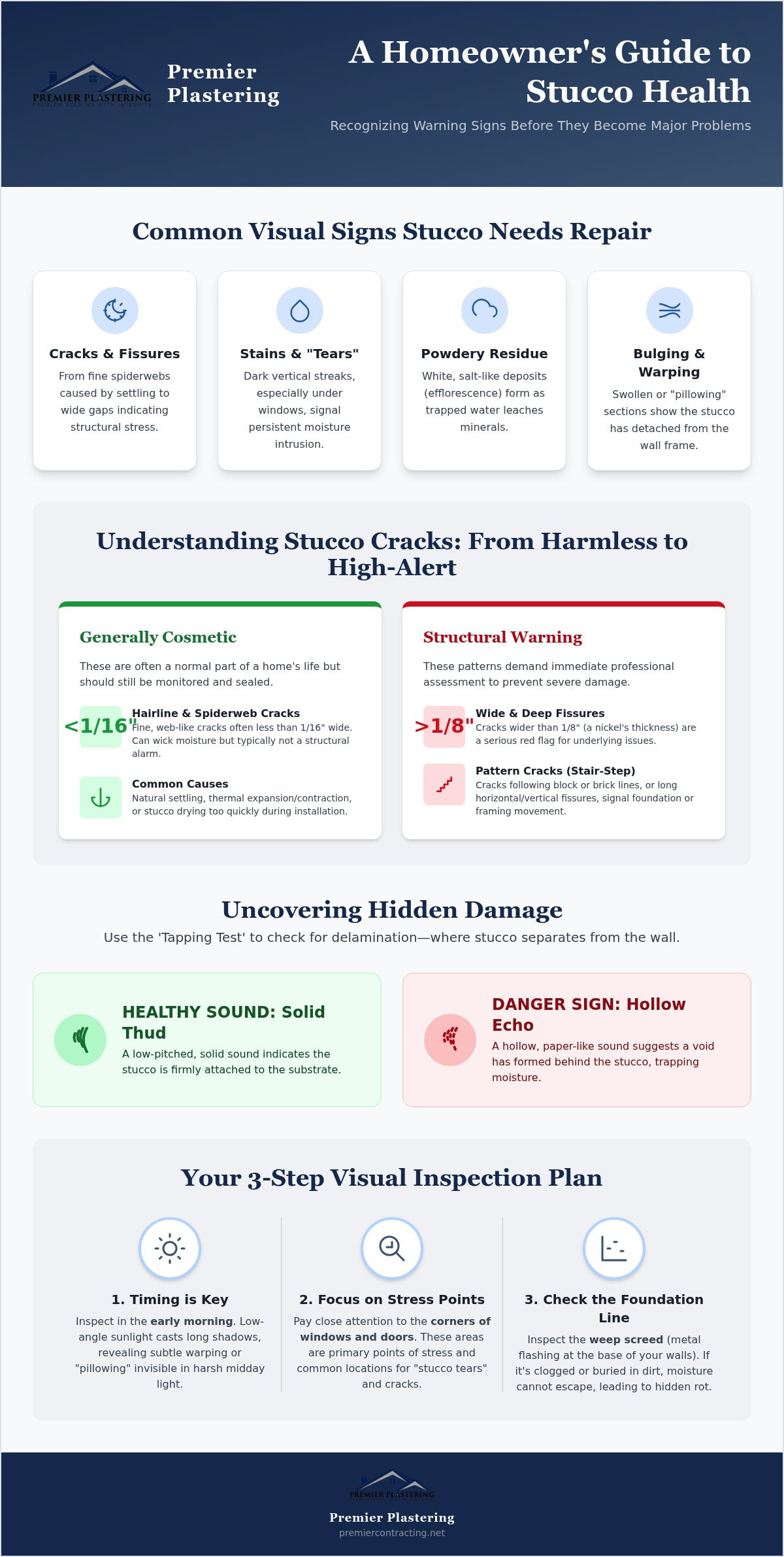
Your home communicates its health through its exterior skin. Identifying the early signs stucco needs repair prevents a minor maintenance task from becoming an invasive reconstruction project. While stucco is incredibly durable, it isn't invincible. It reacts to the shifting earth and the intense Southern California sun. If you catch these visual cues early, you're not just fixing a wall; you're preserving your home's legacy. Use this checklist to evaluate your facade:
- Hairline vs. Structural Cracks: Thin, spiderweb-like lines often result from natural settling. Large, gaping fissures or "stair-step" cracks usually indicate movement in the foundation or framing.
- The Stucco Tear: Look for dark, vertical streaks directly under the corners of window frames or light fixtures. These stains suggest water is getting behind the finish.
- Efflorescence: This white, powdery residue looks like salt. It occurs when moisture leaches minerals out of the material. By Understanding Stucco and its cementitious nature, you can see how this signals a chemical breakdown within the wall.
- Bulging or Pillowing: If a large section of the wall looks "swollen" or pulls away from the house, the stucco has likely detached from the underlying lath.
The Visual Inspection Walkthrough
To get an accurate diagnostic, perform a 360-degree perimeter check of your property. Timing is everything. We recommend doing this in the early morning light. Low-angle sunlight casts longer shadows, making it much easier to spot subtle wall warping or "pillowing" that disappears in the harsh midday sun. Pay close attention to window corners and door frames, as these are primary stress points. Don't forget to inspect the weep screed, the metal flashing at the base of your walls. If it's clogged or buried in dirt, moisture cannot escape, which often leads to hidden rot.
When Cosmetic Wear Becomes a Structural Threat
It's easy to dismiss a small crack as a simple cosmetic flaw. In our arid climate, sun-faded pigment is common and rarely dangerous. However, Southern California's frequent seismic micro-tremors mean that even a "hairline" web can quickly expand. When these small openings exist in high-moisture areas, such as near a faulty rain gutter, they act as funnels for water. Deep staining is a red flag that the water has already reached the wooden substrate. If you ignore these signs, the moisture will eventually compromise the structural integrity of your home's framing, leading to mold and costly interior repairs.
Understanding Stucco Cracks: From Hairline to Structural
Stucco is a rigid material. When the ground beneath your home moves or temperatures fluctuate, the wall must either flex or break. Distinguishing between a minor blemish and a significant structural fissure is the first step in protecting your investment. While some signs stucco needs repair are obvious, others require a more nuanced eye to interpret correctly. A crack isn't just a line on a wall; it's a map of the stresses acting upon your home's skeleton.
The direction of a crack tells a professional exactly what is happening beneath the surface. Vertical cracks usually suggest the house is settling naturally into its footprint. Horizontal cracks are more concerning, as they often indicate the metal lath is rusting or the wooden substrate is absorbing water and swelling. If you see a "stair-step" pattern, pay close attention. This specific shape follows the mortar joints of the concrete blocks or bricks behind the plaster, often serving as an early warning for foundation distress.
Hairline Cracks: Are They Ever 'Normal'?
In Fullerton, our homes endure significant thermal expansion and contraction. The heat of the afternoon sun followed by cool evening breezes causes the building to breathe. Small hairline cracks, often less than 1/16th of an inch, are common in older homes. However, they aren't entirely harmless. Even a tiny gap can act as a capillary, drawing moisture deep into the wall system during our seasonal rains. Spiderwebbing is a network of fine, interconnected cracks caused by improper stucco curing times or the material drying too rapidly during the initial application. Adhering to industry installation standards ensures these curing issues are avoided from the start.
Structural Fissures and Seismic Settling
Orange County’s unique geography makes seismic settling a reality for every homeowner. When a crack exceeds 1/8 of an inch, roughly the thickness of a dime, it has moved beyond the cosmetic category. These structural fissures often reappear even after a homeowner attempts a DIY patch with store-bought caulk. This happens because the underlying movement hasn't been addressed; the "band-aid" simply snaps when the house shifts again. If you've noticed a crack that seems to grow or return every season, it's one of the most reliable signs stucco needs repair by a specialist. A professional assessment can determine if your walls need more than just a surface-level fix.
Moisture Intrusion: Stains, Mold, and Efflorescence
Moisture is the silent adversary of any Southern California home. While our region is known for its sunshine, the occasional heavy rains and morning fog can wreak havoc if your home's exterior is compromised. When water finds a way behind the plaster, it doesn't just sit there. It migrates, swells, and eventually begins to break down the very materials designed to protect you. Recognizing these signs stucco needs repair early can be the difference between a simple patch and a full-scale remediation of your wall's substrate.
The "Stucco Tear" is one of the most common indicators of a failing seal. These are dark, vertical streaks that appear directly beneath the corners of windows, door frames, or outdoor light fixtures. They occur when water seeps behind the trim and leaches out dirt and minerals. Over time, this constant dampness turns porous stucco into a breeding ground for mold and mildew. If you notice persistent dark patches that don't dry out within 48 hours of a rainstorm, your wall system is likely saturated. This level of Moisture Intrusion requires immediate attention to prevent the rot from reaching your home's wooden framing.
Your wall's last line of defense is the weep screed. This is the metal flashing located at the base of your stucco walls. It's designed to allow trapped moisture to exit the wall system safely. If your landscaping or soil has buried this screed, moisture will "wick" upward into the wall instead of draining out. This capillary action is a leading cause of bottom-up stucco failure and hidden sill plate rot.
Identifying Water Damage Signs
It helps to know what you're looking at. Surface dirt runoff usually washes away with a gentle garden hose, but deep-seated rust stains are different. A rust-colored streak indicates that water has reached the metal lath or staples inside the wall. Once the metal begins to oxidize, it expands, causing the stucco to crack and flake off. Don't ignore your nose, either. If you detect a musty or earthy odor inside your home, especially near an exterior wall, it's often a sign that exterior stucco failure has allowed mold to colonize the wall cavity.
Efflorescence and Salt Air Impact
For those living in Huntington Beach or other coastal cities, salt air adds another layer of complexity. Efflorescence appears as a white, chalky powder on the surface of your stucco. It happens when water moves through the cement, dissolves internal salts, and carries them to the surface. Simply painting over this powder is a dangerous mistake. The paint creates a non-breathable barrier that traps the salt and moisture behind the finish. This leads to "spalling," where the face of the stucco literally pops off the wall. Addressing the source of the moisture is the only ethical, long-term fix for these signs stucco needs repair.
The 'Tapping' Test and Substrate Integrity
Stucco is more than a decorative facade. It is a multi-layered system designed to shield your home from the elements, but that protection only works if the layers remain bonded. Delamination occurs when the cement layers pull away from the wire lath or the building's wooden frame. This separation is a progressive failure. It often begins with moisture weakening the bond, which is then exacerbated by the seismic vibrations common in Orange County. When the bond fails, the stucco becomes a rigid shell floating over the house rather than a part of it. This hidden separation is one of the most critical signs stucco needs repair because it compromises the fire-resistant properties of your exterior walls.
You may also notice "bubbling" on the surface of your walls. While some bubbles are mere air pockets from a rushed application, others are far more sinister. A bubble that feels soft or yields under pressure is usually a sign of trapped water. This moisture is actively rotting the substrate behind the plaster. Identifying these soft spots early allows for a targeted restoration before the entire wall span requires replacement.
How to Perform a Stucco Sound Test
You don't need expensive equipment to check for delamination. A simple sound test is a reliable diagnostic tool used by professionals. Follow these steps to map your home's health:
- Step 1: Use your knuckle or a small rubber mallet to gently tap on suspect areas, particularly near cracks or stains.
- Step 2: Listen for the feedback. A sharp, solid thud indicates a healthy, intact bond. A "hollow" or "drum-like" sound suggests the stucco has detached from the lath.
- Step 3: Use a piece of chalk to lightly mark the boundaries of the hollow sound. This helps you determine the scope of the damage.
Exposed Lath and Wire Mesh
Seeing metal through your plaster is an immediate red flag that requires your attention. When moisture reaches the wire mesh, the oxidation process begins. Rusted metal expands significantly, creating internal pressure that forces the stucco to pop off in large chunks. This isn't just an aesthetic concern; it's a safety hazard for your family. Falling stucco can weigh several pounds per square foot, posing a risk to anyone walking near your home’s perimeter. If your tapping test reveals large hollow sections or you see rust bleeding through the surface, these are undeniable signs stucco needs repair. You can schedule a diagnostic inspection to determine if your home requires a simple patch or a more comprehensive structural restoration.
Professional Stucco Restoration: The Premier Plastering Approach
Identifying the signs stucco needs repair is the necessary first step in protecting your home, but the quality of the restoration determines its future. At Premier Plastering, we don't view a repair as a simple construction task. We see it as an act of stewardship for your property. Our "Principled Master Craftsman" philosophy means we approach every patch and texture match with the same meticulous care we would apply to our own family homes in Fullerton. We believe in doing things correctly rather than quickly, ensuring that every fix is both ethical and enduring.
True craftsmanship is most evident in texture matching. In neighborhoods across Anaheim and Yorba Linda, homes feature a variety of stucco styles, from heavy lace to the smooth, hand-troweled "Santa Barbara" finishes currently trending in 2026. Matching a 30-year-old texture is an art form that requires an intimate understanding of material behavior. For homeowners seeking a high-end aesthetic transformation, we also offer Venetian Plastering. This centuries-old technique provides a luminous, marble-like finish that elevates a standard exterior into a luxury landmark while providing exceptional durability against the coastal elements.
Seamless Patching vs. Full Re-Stucco
Deciding between a targeted patch and a full re-stucco requires a clear decision matrix. If your home's substrate is healthy and the damage is localized to specific impact points or minor cracks, a professional patch is often the most responsible choice. We specialize in matching existing textures so perfectly that the repair becomes invisible to the naked eye. However, if you've observed widespread delamination or multiple "soft spots" as discussed earlier, a full remediation may be necessary to meet the 2026 California Building Standards Code. In these cases, we often utilize professional-grade elastomeric coatings. These specialized finishes bridge small cracks and provide a flexible, waterproof shield that moves with your home during seismic shifts.
Restoring Your Home's Virtue and Value
The return on investment for timely stucco restoration is significant for Orange County property values. A well-maintained exterior doesn't just provide curb appeal; it offers potential buyers the peace of mind that the home's structural integrity has been guarded by a professional. Our commitment to ethical communication ensures you'll never face "surprise" costs or hidden fees mid-project. We walk you through the diagnostic findings with clarity and respect, providing a transparent path to restoration. If you've noticed any concerning changes in your home's exterior, don't wait for the next rainy season to see if the damage worsens. Schedule a professional diagnostic with Premier Plastering today and let us help you preserve the virtue of your home.
Preserving Your Home's Integrity for the Future
Your home is a significant investment, and its stucco exterior is the primary defense against the Southern California sun and shifting soil. By learning to recognize the signs stucco needs repair, from the "stucco tear" under windows to the hollow feedback of a tapping test, you've taken a vital step toward long-term property health. Catching these issues early isn't just about curb appeal; it's about preventing moisture from reaching your home's substrate and causing irreversible damage. Understanding these markers allows you to act with confidence rather than worry. Beyond the walls, ensuring your chimney is properly swept and inspected by Absolute Chimney Pros is another essential component of maintaining a safe and resilient home.
When you're ready for an expert opinion, our family-owned team in Fullerton is here to serve as your dedicated guide. We bring a Principled Master Craftsman approach to every project, specializing in expert texture matching that restores your home's original beauty. We treat every restoration with the care and accountability your property deserves. You don't have to navigate these repairs alone. Request a Professional Stucco Inspection from Premier Plastering today to ensure your home remains a safe, beautiful sanctuary for years to come.
Frequently Asked Questions
How much does stucco repair typically cost in Orange County?
The cost of stucco restoration depends on the depth of the damage and the complexity of the texture match. Labor typically accounts for 60% to 70% of a professional job's total investment. While minor surface fixes are simpler, repairs involving water intrusion or substrate rot require more intensive work. A transparent contractor will provide a detailed breakdown based on the specific needs of your home's unique facade.
Can I just paint over hairline cracks in my stucco?
You shouldn't simply paint over hairline cracks because paint is a cosmetic layer that cannot bridge a structural gap. If you apply paint over a crack, moisture can still seep into the wall and become trapped behind the new finish. This often leads to "spalling" or bubbling later. Proper restoration involves filling the crack with a compatible sealant before any aesthetic coatings are applied.
What is the difference between stucco repair and stucco remediation?
Stucco repair focuses on fixing localized issues like a single crack or a small patch of damage. Remediation is a more comprehensive process that addresses the root cause of a system-wide failure. If your home has widespread moisture issues or improper lath installation, remediation involves removing the stucco to fix the underlying structure. Understanding these signs stucco needs repair helps you decide which path is most ethical for your home's longevity.
Does homeowners insurance cover stucco water damage?
Homeowners insurance typically doesn't cover stucco damage resulting from gradual wear, tear, or long-term moisture intrusion. Coverage is usually reserved for sudden and accidental events, such as a localized pipe burst or storm-related impact. Most policies exclude damage caused by poor initial installation or a lack of regular maintenance. This makes early diagnostic checks essential for protecting your property and your wallet.
How long does a professional stucco patch last?
A professional stucco patch can last for 20 to 30 years when executed with high-quality materials and proper technique. The longevity depends heavily on the bond between the new material and the existing substrate. When a master craftsman matches the texture and uses professional-grade coatings, the patch becomes a permanent part of the wall. Maintaining your home's gutters and ensuring your roof is in peak condition with United Roofing & More! will help extend the life of any repair.
Why is my stucco crumbling at the bottom of the wall?
Stucco crumbling at the base of your wall is often caused by "wicking" moisture from the ground or a buried weep screed. When the metal drainage screed at the bottom of the wall is covered by soil or mulch, water cannot escape the wall system. This trapped moisture eventually dissolves the bond between the stucco and the lath. Ensuring proper drainage and clearing the screed is the first step in a lasting restoration.
Can I repair stucco myself or do I need a contractor?
While homeowners can handle very minor cosmetic touch-ups, a professional contractor is necessary for structural repairs and seamless texture matching. Matching the hand-troweled finishes found in many Fullerton homes is a specialized skill that takes years to master. Improper DIY fixes often fail within a single season because they don't address the underlying movement. A seasoned professional ensures the repair is structurally sound and aesthetically invisible.
How does seismic activity in California affect my stucco?
California's frequent seismic micro-tremors place constant stress on rigid stucco systems. Unlike wood or vinyl siding, stucco doesn't flex well. These tiny movements eventually manifest as stress fractures, which are common signs stucco needs repair in our region. Over time, even small tremors can cause the stucco to delaminate from the framing. Regular inspections after significant tremors help catch these hidden separations before they lead to major wall failure.


