

That hairline crack on your exterior isn't just a cosmetic blemish; it's a window into the health of your home's entire structural envelope. You've likely spent mornings staring at a new spiderweb pattern near your window, wondering if it's a simple fix or the start of a five-figure nightmare. It's stressful to feel like you're guessing about the signs of stucco failure while worrying about hidden mold or wood rot. We believe your home deserves the same level of care and honesty that we'd give our own.
This diagnostic guide will teach you to accurately identify early degradation before moisture compromises your wall's structural integrity. You'll learn to distinguish between harmless settling and the deep-seated damage that demands immediate attention. We provide a clear checklist to help you evaluate severity, navigate modern 2026 moisture management standards, and gain the peace of mind that comes from knowing exactly when to call a professional for a seamless repair.
Key Takeaways
- Differentiate between minor surface weathering and systemic failure of the moisture barrier to protect your home's wooden frame.
- Spot the most common signs of stucco failure specific to the Southern California climate before they lead to expensive remediation.
- Apply the 1/16th inch rule to accurately judge whether a crack is a cosmetic blemish or a structural warning sign.
- Understand why artisanal texture matching is the only way to achieve a seamless, invisible repair on your exterior walls.
What Is Stucco Failure and Why Does It Happen?
Stucco failure isn't just a chipped corner or a dirty wall. It's the moment your exterior cladding stops acting as a protective shield and starts letting water reach your home's wooden skeleton. To understand What is Stucco and how it fails, you must see it as a complete system of layers. When the lath or the moisture barrier behind the cement breaks down, you're no longer looking at surface-level wear; you're facing systemic failure.
Catching these signs of stucco failure early is the only way to prevent a minor patch from turning into a full-scale wall remediation. In Fullerton, seismic shifts often trigger the initial cracks that lead to these expensive problems. Identifying these entry points early protects your home’s structural integrity and your family's health.
The Role of Moisture and Seismic Movement
Living in Southern California means your home is constantly subjected to subtle seismic shifts. These micro-movements create hairline fractures in rigid, cement-based finishes. Once a crack opens, a "wicking" effect takes over. Rainwater doesn't just sit on the surface; it gets sucked deep into the crack through capillary action. This moisture eventually reaches the wooden framing, where it can cause rot and mold long before you see a single bubble on the outside. To learn more about protecting your structural framing from moisture-related pests, click here.
Many failures stem from the original installation. If the crew didn't use the right mixing ratios or skipped expansion joints, the wall can't handle natural temperature changes. We often see these common culprits in local homes:
- Missing weep screeds: Without these at the base of the wall, water gets trapped behind the stucco.
- Improper window flashing: Poor seals around frames act like a funnel, directing water straight into the wall cavity.
- Lack of drainage gaps: Modern 2026 standards prioritize rainscreens to ensure the building envelope stays dry.
5 Critical Signs Stucco Needs Repair
Visual symptoms on your home's exterior are often just the tip of the iceberg. In Orange County, identifying the signs stucco needs repair early can save you from catastrophic structural rot. If you ignore a small blemish today, you're essentially inviting moisture to settle behind your walls.
Early intervention through professional stucco crack repair prevents these signs of stucco failure from evolving into full-wall remediation. We see these issues most frequently in Fullerton and surrounding cities where high humidity meets seismic activity.
Discoloration and Efflorescence
Efflorescence appears as a white, powdery residue on your walls. It occurs when water travels through the cement, dissolves internal salts, and leaves them behind as it evaporates. This isn't just a stain; it's a clear signal of moisture intrusion. Similarly, dark streaks or "stucco tears" below window corners indicate that your sealants are failing and directing water into the building envelope.
Cracking, Bulging, and Delamination
Spiderwebbing often points to poor base coat application or a mix that dried too quickly during the initial install. While these look minor, they are common signs of stucco failure that allow wicking. Bulging is far more serious; it means the stucco has physically detached from the metal lath. If the surface feels soft or looks like it's pulling away, the bond is gone and the material could fall at any moment.
Consistent maintenance keeps your home safe and beautiful. If you're unsure about a specific mark, we can help you evaluate your stucco repair needs with a professional eye. We take pride in diagnosing the root cause rather than just covering up the symptom.
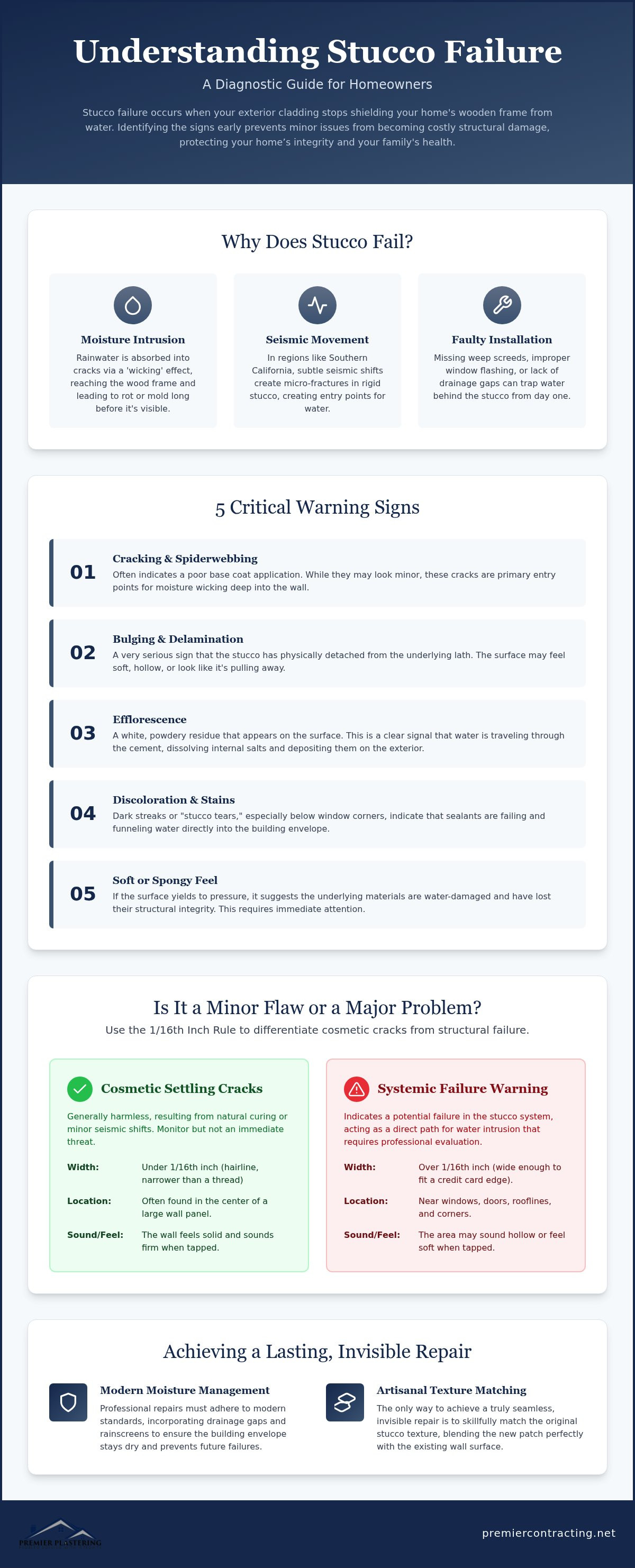
Differentiating Between Cosmetic Cracks and Structural Failure
Not every fracture requires a total wall replacement. We use the 1/16th inch rule as a baseline: if a crack is narrower than a piece of thread, it’s likely a cosmetic settling issue. However, when cracks exceed this width or appear near transition points like windows, doors, and rooflines, they become high-priority signs of stucco failure. These gaps act as entry points for moisture that can quickly compromise your home's building envelope.
| Feature | Settling Cracks | Systemic Failure |
|---|---|---|
| Width | Under 1/16th inch | Over 1/16th inch |
| Location | Center of the wall panel | Corners of windows or roofline |
| Sound/Feel | Solid when tapped | Hollow sound or soft feel |
The Soft Spot and Tap Test
Gently press on any area with dark staining to check for "give" or unusual softness. If the wall feels spongy, water has already compromised the substrate. You can also use the "hollow sound" test by tapping with your knuckles. A sharp "clack" signifies a healthy bond, but a dull, hollow thud indicates the stucco has delaminated from the lath.
When to Consult a Fullerton Stucco Specialist
Seek a stucco contractor in Fullerton when cracks exceed the width of a credit card. Professional moisture probing is often necessary at this stage to rule out hidden rot. We believe in providing honest assessments so you can make the right choice for your home's longevity. If you suspect your exterior is failing, schedule a professional stucco evaluation to secure your property's structural integrity.
Professional Solutions for Exterior Stucco Restoration
Restoring a home's exterior requires more than a bucket of cement and a trowel. We treat exterior stucco restoration as a surgical procedure designed to heal the building envelope. As a Principled Master Craftsman, our goal is to address the root cause of the signs of stucco failure so the repair lasts for decades rather than months.
A high-quality patch involves removing every inch of compromised material until we reach a sound substrate. We never just smear new material over old, failing layers. This methodical approach ensures that the bond is permanent and the moisture barrier is fully restored.
The 3-Step Patching and Texture Matching Process
We follow a disciplined framework to ensure structural integrity and visual beauty:
- Step 1: Removal and Inspection. We cut back damaged sections to reveal the underlying lath and moisture barrier. If we find rot in the wooden framing, we address it before proceeding.
- Step 2: The 3-Coat System. We apply a scratch coat for the bond, a brown coat for leveling, and a finish coat for protection. This traditional method provides the durability modern homes need.
- Step 3: Artisanal Texture Matching. Matching the existing pattern is an art form. We meticulously replicate the original sweep or dash to make the repair invisible.
Long-Term Stucco Maintenance Strategies
Protecting your investment means staying ahead of the signs of stucco failure with consistent care. Perform annual inspections of the caulking around your windows, doors, and utility penetrations. If the seals look brittle or cracked, replace them immediately to prevent water from slipping behind the cladding. Just as you would consult Best Chimney Services to maintain your home's ventilation and heating safety, these exterior checks are vital for structural health.
For added protection, consider an elastomeric coating. These specialized finishes bridge small hairline fractures and provide a flexible, waterproof shield that moves with your home during seismic shifts. This proactive step ensures your walls remain beautiful and structurally sound regardless of the weather or ground movement.
Identifying the early signs of stucco failure is the most effective way to prevent costly remediation and preserve your property's value. By applying the 1/16th inch rule and performing the tap test, you've taken the first step toward responsible home ownership. It's vital to remember that your exterior is a complex system where small hairline fractures can lead to significant internal moisture damage if left unaddressed.
As a family-owned business serving Fullerton and Orange County for years, we treat every repair with artisanal care and quiet pride. Our specialized approach focuses on seamless texture matching and structural integrity to ensure your home looks beautiful and stays dry. We believe in doing the right thing for our neighbors, even when the work is hidden behind the final finish coat.
Request a Professional Stucco Inspection from Premier Plastering to gain total peace of mind regarding your home's safety. You don't have to navigate these structural concerns alone; we are here to provide the expert guidance you deserve.
Frequently Asked Questions
How do I know if my stucco cracks are serious?
Serious cracks are wider than 1/16th of an inch or located near transition points like windows and doors. These gaps allow water to bypass the exterior and reach your home's wooden frame. If you see brown staining or feel softness around the fracture, it indicates active water intrusion. We recommend measuring cracks with a credit card; if the card fits inside, you need professional intervention immediately.
Can I just paint over failing stucco to seal it?
Painting over damaged areas is a temporary mask that often traps moisture inside the wall. While it might hide the signs of stucco failure for a few months, it won't fix delaminated sections or compromised lath. Trapped water can accelerate wood rot and mold growth behind the cladding. A proper repair involves removing the damaged material and restoring the moisture barrier before applying a new artisanal finish.
What causes stucco to bulge or feel soft?
Bulging occurs when the stucco bond fails and the material detaches from the metal lath or substrate. This is usually caused by long-term water intrusion that has rusted the lath or rotted the underlying wood. Softness is a critical warning that the internal structure is saturated. In our local Fullerton climate, these issues often stem from failing window sealants or missing weep screeds at the foundation line.
How much does it cost to repair failing stucco in Fullerton?
Repair costs in Fullerton depend on the damage severity and the total square footage involved. Minor cosmetic patches for hairline cracks are less intensive than structural remediation for systemic water damage. Because every home in Orange County has a unique texture and underlying condition, we provide detailed assessments to determine an accurate scope of work. Doing the job right the first time prevents expensive full-wall replacements later.
Is efflorescence on stucco a sign of a leak?
Efflorescence is a white, powdery mineral deposit that proves water is moving through your stucco system. While it isn't always a high-volume leak, it is a clear indicator of moisture intrusion. When water evaporates from the cement, it leaves these salts behind on the surface. This process suggests your moisture barrier or sealants are failing, which are common signs of stucco failure in Southern California homes.


