

What if those hairline cracks on your Fullerton home aren't just an eyesore, but a quiet warning that your property's structural envelope is beginning to fail? It's a common anxiety for Southern California homeowners, especially when you suspect hidden water damage might be lurking behind the surface. You've likely seen homes with mismatched patches that look like scars on the exterior, leaving you frustrated and confused about the real cost-benefit of a repair. A proper exterior stucco restoration is more than a quick fix. It's an artisanal discipline that blends structural engineering with old-world plastering techniques to preserve your home's soul.
We understand that your home is your most significant investment. You deserve the peace of mind that comes from a seamless, durable exterior that looks brand new and stands up to the elements. In this guide, you'll discover the technical framework and artisanal secrets to restoring your property's stucco to its original structural integrity. We'll walk through the impact of the 2025 California Building Standards Code, the nuances of expert texture matching, and how high-end finishes can substantially increase your property value. This is your roadmap to a beautiful, waterproofed home built to last for generations.
Key Takeaways
- Understand how stucco functions as your home's breathable skin and why maintaining the structural lath is vital for long-term protection.
- Master the 5-stage framework for a professional exterior stucco restoration to ensure your project moves logically from diagnosis to a clean, aesthetic finish.
- Learn why standard patches often fail within two years and how to choose restoration methods that respect the chemical integrity of your building.
- Explore the artisanal techniques behind seamless texture matching and the high-end appeal of Venetian plaster for a timeless Southern California look.
- Gain the clarity needed to select a principled craftsman in Fullerton or Yorba Linda who prioritizes local building codes and ethical workmanship.
Understanding the Science of Exterior Stucco Deterioration
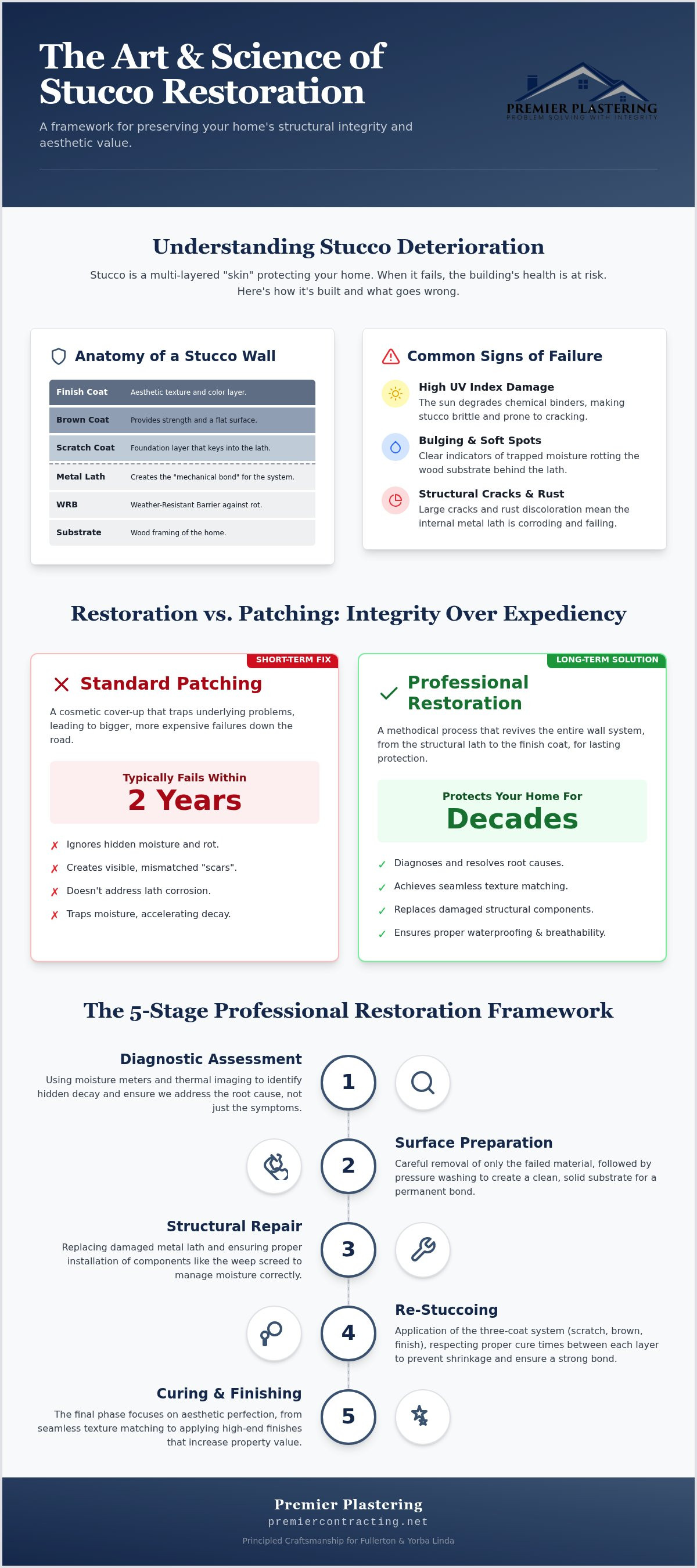
Stucco is far more than a decorative finish; it's a complex, multi-layered system designed to protect your home's structural integrity. A true exterior stucco restoration isn't just about applying a fresh coat of paint or filling a few holes. It's the methodical process of reviving both the underlying structural lath and the cementitious layers that have weathered over time. We view your home's exterior as a breathable skin, or an "envelope," that must allow moisture vapor to escape while preventing liquid water from entering. When this envelope fails, the building's health is at risk.
In Southern California, our high UV index is the primary catalyst for material failure. While many believe rain is the biggest threat, the sun's intense radiation specifically attacks the chemical binders within the stucco. As these binders degrade, the material loses its natural flexibility and becomes brittle. This brittleness invites "silent killers" like efflorescence, which is the white, powdery salt left behind by evaporating water. Left unchecked, this leads to delamination, where the stucco layers literally peel away from the structure, and hairline fractures that act as straws, sucking moisture directly into your walls.
The Anatomy of a Stucco Wall
Understanding how your walls are built helps you see why professional restoration is so vital. It starts with the substrate, usually wood framing, covered by a weather-resistant barrier (WRB). This barrier is your last line of defense against rot. On top of that, we install a metal lath, which creates the "mechanical bond" that holds the entire system together. We then apply a traditional three-coat system:
- The Scratch Coat: The foundational layer that keys into the metal lath.
- The Brown Coat: A leveling layer that provides structural strength and a flat surface.
- The Finish Coat: The final aesthetic layer that defines the texture and color of your home.
Common Signs Your Stucco Needs More Than a Patch
While surface-level spiderweb cracking is often a result of natural curing or minor temperature shifts, structural settling cracks require deeper attention. These larger gaps suggest the building's "envelope" has been breached. You should also look for bulging or soft spots. These are clear indicators that moisture is trapped behind the lath, likely rotting the wood substrate. If you notice rust-colored discoloration, it's a sign that the internal metal lath is corroding. At this stage, a simple patch won't suffice; you need a comprehensive exterior stucco restoration to save the underlying structure from failing completely.
The 5-Stage Professional Stucco Restoration Framework
Restoration isn't a weekend project; it's a disciplined journey that requires patience and precision. A successful exterior stucco restoration moves methodically from diagnostic evaluation to the final aesthetic curing. We maintain a clean, organized job site because respect for your property is as important as the quality of the plaster. One of the biggest mistakes in this trade is rushing the "cure time" between coats. Rushing leads to shrinkage cracks and compromised bonds, which is why we follow a strict timeline that respects the chemistry of the material. This intersection of modern waterproofing and traditional tools ensures your home remains protected for decades.
Phase 1 & 2: Diagnostic Assessment and Surface Preparation
True craftsmanship begins with an honest assessment. We use moisture meters and, when necessary, thermal imaging to identify hidden decay that the naked eye misses. This diagnostic phase ensures we aren't just covering up a problem. Our principled approach to removal means we only take what's necessary to ensure a solid bond with the healthy substrate. Principles of historic stucco restoration remind us that preserving original material is always the goal, provided it's structurally sound. Once the bad material is gone, we use pressure washing and chemical cleaning to strip away decades of Orange County dust and salts.
Phase 3, 4, & 5: Structural Repair, Re-Stuccoing, and Curing
The middle and final stages focus on rebuilding the wall's strength. We replace damaged metal lath and verify that the weep screed at the base of the wall is functional. This allows moisture to exit the system rather than rotting your foundation. If you're concerned about the current state of your home's envelope, professional stucco services can provide the clarity you need to move forward with confidence. The application of the "brown coat" is a critical step; it levels the surface and prepares it for a perfect finish.
Finally, we enter the hydration period. It might seem counterintuitive to spray water on fresh work, but "wetting down" the stucco is essential. It slows the drying process, allowing the cement to reach its full design strength. We follow these steps meticulously because we believe in doing the right thing for the building, even when the homeowner isn't watching. This commitment to process is what separates a long-lasting restoration from a temporary fix.
Restoration vs. Patching: Choosing Integrity Over Expediency
Choosing a quick patch over a full restoration often feels like a smart financial move in the moment. However, homeowners frequently fall into the "Band-Aid trap." Small, localized patches often fail within 24 months because they don't address the underlying system. When we look at the lifecycle of a building, we view exterior stucco restoration as a commitment to the next 50 years of your property's health. It's an investment in the building's envelope that prevents the cycle of recurring, expensive repairs. The financial math is simple: paying for one professional restoration is significantly cheaper than paying for five separate, failed repairs over a decade.
One of the technical reasons patches fail is the mismatch in material pH levels. New stucco is highly alkaline. Over decades, your original stucco has carbonated and its pH has shifted. When you slap new material onto old without proper preparation, this chemical difference can cause the new patch to "pop" off or delaminate as they expand and contract at different rates. According to technical guidelines for Stucco Restoration, maintaining the continuity and chemical compatibility of the cementitious layers is paramount for a bond that lasts. We don't just fill holes; we ensure the new material respects the chemistry of the old.
The Problem with 'Quick Fix' Stucco Patching
Store-bought patch kits rarely offer the flexibility needed for a permanent fix. These products often struggle with texture matching, leaving your home with noticeable "scars" that lower curb appeal. Beyond the look, the biggest risk is the "cold joint." This is the microscopic gap between the old stucco and the new patch where moisture easily enters. If a contractor ignores the root cause, such as faulty window flashing or a failing weep screed, they're just hiding a problem that will eventually lead to structural rot.
The Master Craftsman's Approach to Seamless Integration
We treat every home in Fullerton or Anaheim Hills as a unique architectural puzzle. Achieving an invisible transition requires the artisanal skill of "feathering" the edges. We don't just stop at the crack; we blend the new layers deep into the surrounding area. Our custom color blending also accounts for the natural UV fading of your original walls. This meticulous process ensures that when the project is finished, you won't be able to tell where the old wall ends and the restoration begins. It's about doing the right thing for the building and the homeowner, ensuring peace of mind through disciplined workmanship.
Preserving Aesthetics: Texture Matching and Venetian Plaster Finishes
Texture is the fingerprint of your home. It's the subtle play of light and shadow that defines a building's character and historical context. When performing an exterior stucco restoration, matching this fingerprint is the most challenging and rewarding part of our craft. In Orange County, we see a vast spectrum of architectural styles, from the heavy, textured lace found on 1970s Fullerton ranch homes to the sleek, minimalist lines of modern estates in Anaheim Hills. A seamless match requires more than just the right material; it demands a steady hand and a disciplined eye that only comes from years of working with the hawk and trowel.
Traditional Stucco Textures: Sand, Dash, and Lace
Traditional textures like sand, dash, and lace each have their own rhythm. For instance, the "Smooth Santa Barbara" finish has become a modern favorite because of its elegant, understated look. However, achieving this level of smoothness without visible trowel marks is an exercise in patience and precision. We treat these finishes with the respect they deserve, ensuring that every repair is unnoticeable to the naked eye. Our commitment to doing the right thing for the building means we don't settle for "close enough" when it comes to your home's aesthetic integrity. We take the time to study the original application to replicate the exact movement of the previous artisan.
Elevating the Exterior with Venetian Plastering
For homeowners looking to transcend standard finishes, we offer specialized Venetian plastering services. This isn't your typical acrylic stucco. Venetian plaster is a lime-based finish that brings a natural, multi-layered depth and luminosity to your exterior. It's an old-world Italian technique that we've adapted for the Southern California climate. Unlike synthetic finishes that can trap moisture, lime plaster is naturally breathable. This breathability is a critical advantage in coastal environments like Huntington Beach, where salt air and high humidity can lead to mold and mildew on lesser materials.
Venetian plaster also offers a unique spectrum of customization, from highly polished, marble-like surfaces to more rustic, earthy textures. Because it's a mineral-based product, it's incredibly durable and resistant to the intense UV radiation that degrades standard paint and acrylic binders. It doesn't just look beautiful; it's a structural investment in your home's longevity. Whether you're restoring a historic villa or elevating a contemporary build, these high-end finishes provide a level of sophistication and durability that standard products simply cannot match. We take pride in delivering a finish that feels as good as it looks, providing you with a home that stands out for all the right reasons.
Selecting a Master Craftsman for Your Orange County Restoration
Selecting the right partner for your exterior stucco restoration is a decision that impacts your home's health for decades. In Southern California, local expertise isn't just a convenience. It's a necessity for navigating the specific permitting and building codes in cities like Fullerton and Yorba Linda. You need a craftsman who understands the local environment. They must know the rigorous standards required to ensure a project is legally and structurally sound. We believe in a "Virtue Test" when vetting contractors. Ask them how they plan to address the weep screed and window flashing. If a contractor dismisses these critical components as unnecessary, it's a significant red flag that they're cutting corners where it matters most.
There is a profound difference when you work with a family-owned and operated business. At Premier Plastering, led by Corey, personal accountability is woven into every layer of our work. We don't hide behind corporate layers or detached project managers. When you trust us with your home, you're entering a partnership where honesty and respect are the baseline. If you are looking for similar high-end restoration expertise in the Southwest, you can visit Crandall Painting & Stucco to see their work on luxury properties. We treat every project with a level of care that feels earned, ensuring that the human element of the trade is never lost in the technical details of the plastering process.
Vetting for Technical Expertise and Ethical Standards
Technical expertise should be balanced with ethical standards. A master craftsman should be able to explain the chemistry of the binders they use and why they're appropriate for your specific substrate. Look for a portfolio that demonstrates a mastery of both structural repair and high-end decorative finishes. This balance shows they understand the building's envelope as well as its aesthetic value. Transparency is also key to a successful partnership. A disciplined professional will provide clear, logical timelines and regular updates, ensuring you're never left in the dark about the progress of your exterior stucco restoration.
The Premier Plastering Difference
Our "Principled Master Craftsman" philosophy is applied to every project, whether we're working on a sprawling estate in Villa Park or a classic home in Anaheim Hills. We understand that your property is your sanctuary. This is why we take meticulous care to protect your landscaping and surrounding environment throughout the restoration process. We leave every job site as clean as we found it, respecting the space you live in. We take immense pride in the quiet, steady pace of our work, focusing on doing things correctly rather than quickly. If you're ready to move beyond temporary patches and invest in the long-term integrity of your home, Schedule a professional diagnostic assessment for your stucco today. Let's work together to restore your home's beauty and structural resilience.
Investing in Your Home's Structural Legacy
Protecting your Southern California property requires more than surface-level fixes; it demands a deep understanding of the building's envelope and the chemistry of its materials. We've explored how a methodical 5-stage framework and the choice of high-end finishes like Venetian plaster can transform a failing exterior into a durable work of art. By prioritizing structural integrity over the "Band-Aid" trap of quick patching, you ensure your home remains a safe and beautiful sanctuary for decades. You're not just maintaining a wall; you're preserving the soul of your architecture.
Choosing a professional exterior stucco restoration is a commitment to quality that transcends simple maintenance. At Premier Plastering, we bring family-owned Fullerton craftsmanship and virtue-based service standards to every project we undertake. We believe in doing the right thing for your home, even in the technical details that remain hidden behind the final finish. As expert Venetian plastering specialists, we're dedicated to delivering results that stand the test of time. You deserve a partner who treats your investment with the same care and accountability as their own.
Ready to secure your property's future with principled workmanship? Request Your Meticulous Stucco Assessment from Premier Plastering today. Let's work together to restore the strength and elegance your home deserves.
Frequently Asked Questions
How long does a full exterior stucco restoration typically take?
A complete exterior stucco restoration generally takes between two and four weeks for a standard residential property. This timeline accounts for the essential drying and curing periods between the scratch, brown, and finish coats. We don't rush these stages because the material needs time to reach its full design strength. Factors like the size of your home and the local weather in Fullerton can influence the final schedule.
Can you match the texture of my 50-year-old stucco perfectly?
We take great pride in our ability to replicate textures from any era, including 50-year-old finishes. Whether your home features a heavy lace, sand, or dash texture, our team uses a disciplined eye to match the original pattern. This artisanal skill ensures that repairs are unnoticeable. We treat your property's unique texture as a fingerprint that must be respected and preserved during the restoration process.
Is Venetian plaster durable enough for the exterior of a home in Southern California?
Lime-based Venetian plaster is exceptionally durable and well-suited for the Southern California climate. Unlike synthetic finishes, it's naturally breathable and resistant to the intense UV radiation that can degrade traditional binders. This makes it an ideal choice for coastal areas like Huntington Beach, where salt air is a constant factor. It offers a high-end, luminous aesthetic that actually strengthens over time as it carbonates.
What is a weep screed, and why is it critical for my stucco's health?
A weep screed is a specialized metal flashing installed at the base of your exterior walls. It's critical because it provides a dedicated exit point for moisture that naturally migrates through the stucco system. Without a functional weep screed, water can become trapped behind the lath, leading to hidden wood rot and foundation damage. Ensuring this component is clear and operational is a cornerstone of our principled approach.
Do I need to move out of my house during the stucco restoration process?
You don't need to vacate your home during the restoration process since all work is performed on the exterior. We maintain a clean and disciplined job site to minimize the impact on your daily routine. You can expect some noise during the removal of old material and application of new layers, but your interior living space remains completely separate. We prioritize clear communication to keep you informed of our daily progress.
How much does exterior stucco restoration increase property value in Orange County?
While we don't provide specific dollar amounts, homeowners in Orange County often see a substantial increase in property value following a professional exterior stucco restoration. High-end finishes and verified structural waterproofing improve both curb appeal and buyer confidence. Investing in a durable, waterproofed exterior signals that the property has been meticulously maintained. This often results in a higher market position compared to homes with visible cracks or mismatched patches.
Can you repair stucco that has been painted over many times?
We can certainly restore stucco that has been painted, but it requires a methodical approach to ensure a proper bond. Multiple layers of paint can act as a barrier that prevents new stucco from adhering to the original surface. If you are planning a complete exterior update, Pro Painter USA provides professional painting services that can be coordinated with your restoration. We typically use specialized bonding agents or perform a light sandblasting to create a clean, receptive substrate, ensuring the new restoration layers integrate perfectly for long-term durability.
What is the best time of year to perform stucco restoration in Fullerton?
The mild temperatures of Spring and Fall offer the most stable conditions for stucco work in Fullerton. Extreme Summer heat can cause the material to dry too quickly, which increases the risk of shrinkage cracks. Likewise, we avoid periods of heavy rain to protect the curing process. By choosing a time with moderate humidity and temperate weather, we ensure the cementitious layers hydrate properly and achieve their maximum structural integrity.


