

What if the hairline crack on your exterior wall isn't a sign of structural failure, but a simple request for a little expert attention? You might find yourself asking how long does stucco last when you spot a bit of discoloration or a small fissure near a window frame. It's completely natural to feel a sense of unease about hidden water damage. Many homeowners face confusion over different stucco types or feel a healthy skepticism toward contractors who push for expensive, full-scale replacements at the first sign of wear.
I understand that your home is your most significant investment and a place where you deserve total peace of mind. In this analysis, you'll discover the true lifespan of stucco and the professional maintenance framework required to protect your home for over 50 years. We'll walk through a diagnostic checklist to evaluate your own walls and examine why a principled approach to repair often outweighs the need for a total overhaul. By the end, you'll have the clarity needed to make an informed, confident decision for your home's architectural legacy.
Key Takeaways
- Traditional three-coat stucco can provide an architectural legacy for 50 to 80 years, while synthetic alternatives typically require more frequent attention after 30 years.
- Understand how the intense Southern California sun and Mediterranean climate specifically affect your home’s pigments and binding agents over time.
- Identify why the weep screed is the most critical component for moisture management and how its integrity dictates the true health of your walls.
- Learn a professional maintenance framework to understand exactly how long does stucco last when supported by consistent, high-quality care and small interventions.
- Gain the clarity to distinguish between surface wear and structural failure, allowing you to choose ethical restoration over costly, unnecessary replacements.
The Expected Lifespan of Traditional and Synthetic Stucco
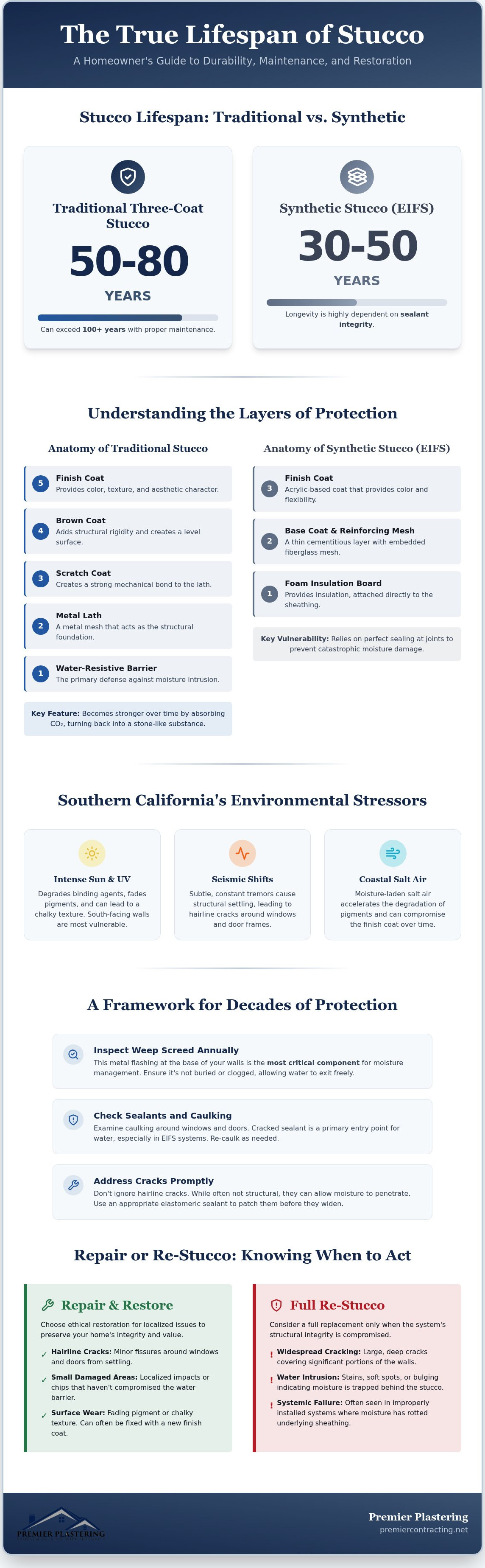
Stucco is one of the most enduring siding materials in architectural history. It isn't just a layer of "mud" on a wall; it's a protective limestone-like shell that guards your home against the elements. When homeowners ask how long does stucco last, they are often surprised to learn that a well-applied system can easily outlive the mortgage, the roof, and even the original windows. Traditional three-coat stucco has a baseline longevity of 50 to 80 years, though it's not uncommon to see century-old homes in Fullerton with their original plaster still standing proud.
This remarkable durability is due to the "living" nature of cement-based products. Unlike wood that rots or vinyl that becomes brittle, traditional stucco undergoes a carbonation process. As the Portland cement cures over decades, it absorbs carbon dioxide from the atmosphere. This chemical reaction essentially turns the material back into a hard, stone-like substance. It is a material that values time, growing more resilient as it matures. Understanding the differences between Traditional and synthetic stucco is the first step in managing your home's lifecycle.
The Anatomy of Traditional Three-Coat Stucco
The strength of traditional stucco lies in its methodical, layered application. It begins with a metal lath and a high-quality water-resistive barrier. These act as the foundation and the primary defense against moisture. Upon this, we apply the scratch coat to create a mechanical bond. This is followed by the brown coat, which provides structural rigidity and a level surface. Finally, the finish coat provides the aesthetic character. This thick assembly creates a rigid, fire-resistant barrier that protects the wooden framing of your home with the permanence of masonry.
Modern Synthetic Systems (EIFS) and Longevity
Synthetic stucco, or Exterior Insulation and Finish Systems (EIFS), offers a different set of characteristics. These systems typically last between 30 and 50 years. While traditional stucco is rigid, synthetic systems utilize acrylic polymers that provide a degree of flexibility. This makes them less prone to hairline surface cracking. However, because EIFS is a multi-layered system involving foam insulation and thin base coats, it lacks the massive density of cement. It relies heavily on the integrity of its sealants. To ensure how long does stucco last in a synthetic application meets its full potential, you must be diligent about inspecting joints and caulking. These are the primary points where moisture can compromise the system.
Southern California Environmental Factors Influencing Stucco Durability
The Mediterranean climate of Orange County offers many benefits for residents, but it presents a unique set of challenges for your home's exterior. While stucco is incredibly resilient, the intense Southern California sun acts as a constant environmental stressor. Over decades, high UV exposure can slowly degrade the binding agents in the finish coat, leading to a chalky texture or a loss of pigment vibrancy. This is particularly evident in Fullerton’s historic neighborhoods, where maintaining the original architectural aesthetic requires a deep understanding of how these local stressors interact with aged materials.
When assessing how long does stucco last in a place like Orange County, we must look beyond the simple age of the structure. We have to consider the orientation of the walls and the specific micro-climate of your street. A home's southern exposure often shows signs of surface wear years before the shaded northern side. If you notice early signs of fading or surface degradation, seeking professional stucco services early can prevent these minor environmental impacts from becoming deeper structural concerns.
Seismic Shifts and Micro-Cracking
Southern California is defined by its frequent, often imperceptible seismic activity. While these minor tremors might not knock pictures off your walls, they cause subtle structural settling throughout the year. In areas like Anaheim Hills or the older residential blocks of Fullerton, this movement creates immense pressure on the rigid stucco shell. These stresses typically manifest as hairline cracks around window corners or door frames where the house naturally flexes. Constant seismic movement stresses the rigid stucco shell until the material's tensile strength is surpassed, requiring expert patching to restore the protective barrier.
Coastal Salt Air and Moisture Intrusion
For homes in coastal Orange County, such as Huntington Beach, the environment is even more demanding. Salt-laden air is highly corrosive. If moisture carries these salts through a breached surface or an improperly sealed joint, it can accelerate the oxidation of the metal lath hidden beneath the plaster. This process often leads to "efflorescence," which appears as a white, powdery crystalline deposit on your walls. These salt deposits are more than just an eyesore; they indicate a moisture cycle that is actively pulling minerals out of the cement. Addressing these cycles quickly ensures your home remains a safe, dry sanctuary for your family.
Why Stucco Fails: Common Culprits Behind Early Degradation
When homeowners ask how long does stucco last, they are often looking at a calendar. However, longevity is not just a matter of years; it is a direct result of the integrity of the original installation and the environment surrounding the home. Even the most robust Portland cement cannot overcome fundamental engineering flaws. Many failures that people attribute to "old age" are actually the result of persistent, invisible stressors that have finally reached a breaking point. A wall that should have lasted eighty years might fail in twenty because its basic needs were ignored.
One frequent culprit is landscaping that sits too high against the foundation. When soil, mulch, or decorative stone makes direct contact with the wall, it creates a "wicking" effect. This pulls ground moisture up into the plaster, bypassing the home’s internal drainage design. Similarly, improper flashing around windows and doors creates hidden entry points for water. Once moisture gets behind the rigid stucco shell, it has nowhere to go. This leads to wood rot and structural compromise long before the material itself should have reached the end of its life.
The Critical Role of the Weep Screed
The weep screed is a specialized metal flashing located at the base of your exterior walls. Its primary job is to provide a dedicated exit path for moisture that naturally permeates the stucco. Unfortunately, many homeowners unknowingly block this critical component during backyard renovations or landscaping projects. When the screed is buried under a new concrete patio or hidden by raised flower beds, water becomes trapped against the wooden framing. You can learn more about identifying these specific vulnerabilities in our guide on the critical role of the weep screed. Keeping this drainage path clear is one of the simplest ways to protect your home’s health.
Installation Errors and Material Quality
The quality of the initial application dictates the entire lifecycle of your exterior. Some contractors attempt to save time by providing "thin" applications that skip the essential brown coat, which is a direct violation of the 2025 California Building Standards Code (Title 24) requiring three coats over metal lath. This shortcut severely compromises the structural rigidity of the wall. Additionally, the hydration process during curing is a delicate art. If the stucco dries too quickly in the hot Orange County sun without proper misting, it becomes brittle and prone to deep cracking. We believe in using high-quality materials and artisanal techniques that respect the science of the trade. A principled master craftsman knows that doing the job correctly the first time is the only way to guarantee how long does stucco last on your property.
Proactive Maintenance: A Framework for Decades of Protection
Viewing your home’s exterior as a living shield allows you to move from a mindset of reactive repair to one of principled stewardship. The secret to how long does stucco last isn't found in the material alone, but in the consistency of the care it receives. In prestigious Orange County communities like Villa Park, the pristine appearance of a home is a testament to its architectural legacy. We believe that small, methodical interventions are the most ethical way to prevent the need for catastrophic, full-scale replacements. A Master Craftsman approach focuses on preserving the integrity of the original work through disciplined observation and timely action.
For most homes in Fullerton and the surrounding hills, a thorough professional inspection should occur every two to three years. This isn't just about aesthetics; it's about verifying that the moisture management systems we discussed earlier are still functioning as intended. Consistent maintenance ensures that your home remains both beautiful and structurally sound, providing a level of reliability that only comes from expert attention.
The Annual Stucco Inspection Checklist
You don't need to be a professional to spot the early warning signs of wear. Once a year, walk the perimeter of your home and look for specific indicators of distress. It's helpful to distinguish between "spider-web" cracking, which is often just surface shrinkage, and deep structural cracks that may indicate settling. You should also gently tap on any areas that look slightly raised. A hollow, drum-like sound suggests delamination, where the stucco has pulled away from the lath. If you identify these issues, consult our Signs Stucco Needs Repair guide for a more detailed diagnostic breakdown.
Cleaning and Patching Best Practices
Keeping your walls clean is a vital part of the maintenance framework. We recommend a low-pressure wash once a year to remove the salt and dirt that can trap moisture against the surface. Never use a high-pressure setting, as this can force water into the pores of the cement and cause damage. When you do find a breach, immediate stucco crack repair is the only way to stop water intrusion before it reaches the wooden framing. This requires an artisanal touch to ensure texture matching is seamless. A patch should never look like a scar; it should disappear into the original finish, maintaining the home's visual harmony. This level of detail is the true answer to how long does stucco last when excellence is the standard.
If you suspect your home’s protective shell has been compromised, our team is here to provide a meticulous evaluation through our expert stucco services.
Stucco Restoration: Knowing When to Repair vs. Re-Stucco
Deciding between a targeted fix and a full-scale overhaul is one of the most significant choices you'll make for your home’s exterior. While many contractors push for a complete replacement at the first sign of trouble, a principled approach often favors preservation. We believe that most stucco can be saved through meticulous residential stucco repair, provided the underlying structure remains sound. The question of how long does stucco last is often answered by your willingness to invest in restoration rather than simply starting over. It's a choice that respects both the history of the structure and your financial resources.
There is a practical tipping point to consider when evaluating your walls. An industry rule of thumb suggests that if the failed area of stucco exceeds 30% of a single wall plane, a full re-stucco is generally more cost-effective over a ten-year period than repeated patching. Below that threshold, restoration is almost always the superior choice for both your budget and the home’s architectural integrity. We look for ways to extend the life of your existing plaster whenever possible, treating every project with the same care as our own personal endeavors.
The Restoration Advantage
Restoration offers an artisanal advantage that complete replacement cannot match. Techniques like "fog coating" or "re-dashing" allow us to refresh the color and seal the surface without the destructive process of tearing everything down. This is where the mastery of seamless stucco repair becomes essential. We take great pride in matching the existing texture and grit so perfectly that the human eye cannot distinguish the new intervention from the original finish. It’s about maintaining visual harmony across the entire facade.
When Replacement is the Only Option
There are certain instances where removal is the only ethical path forward. If we discover widespread wood rot behind the metal lath or systemic moisture intrusion that has compromised the framing, a simple patch won't solve the core problem. Additionally, if your home has been layered with multiple coats of thick, non-breathable paint over the decades, the stucco may no longer be able to shed moisture properly. This leads to inevitable delamination and bubbling. In these complex cases, it's wise to consult a stucco contractor in Fullerton who can provide a transparent assessment. We’ll always tell you the truth about how long does stucco last on your specific home, even if the right answer involves more work than a simple repair.
Protecting Your Home’s Architectural Legacy
Your home is more than just a structure; it's a testament to tradition and careful stewardship. We've explored the material science behind traditional three-coat systems and the vital role of moisture management in our unique climate. Ultimately, the true answer to how long does stucco last depends on the consistency of your care and the expertise of the partners you choose. By spotting minor cracks early and respecting the function of your drainage systems, you ensure your home remains a resilient sanctuary for decades to come.
Our family-owned expertise since 2026 is built on a foundation of artisanal integrity and a deep commitment to Orange County homeowners. We specialize in meticulous, seamless texture matching that restores your home's original character without the need for unnecessary, costly replacements. If you’re ready to move from uncertainty to a clear plan for your exterior, Schedule a Professional Stucco Assessment with Premier Plastering today. Let’s work together to preserve the beauty and strength of your property for the next fifty years.
Frequently Asked Questions
How long does traditional stucco last compared to vinyl siding?
Traditional stucco lasts 50 to 80 years, significantly outperforming vinyl siding, which typically requires replacement after 20 to 30 years. Vinyl often fades, cracks, or warps due to UV exposure and thermal expansion. In contrast, the cement-based nature of stucco provides a rigid, fire-resistant shell that handles the Southern California sun with greater grace. Investing in stucco means choosing a multi-generational material over a temporary plastic covering.
Can stucco last 100 years?
Yes, it's entirely possible for traditional three-coat stucco to last a century or more when properly maintained. Many historic homes in Fullerton and surrounding Orange County cities still feature their original plaster from the early 1900s. The key to reaching this milestone is ensuring the internal drainage systems, like the weep screed, remain unblocked. When moisture can escape and the surface is kept clean, the material remains structurally sound indefinitely.
Is it normal for new stucco to have hairline cracks?
Minor hairline cracks are a common part of the curing process as the material naturally shrinks and settles. These often appear within the first year as the Portland cement dries and the home’s wooden framing adjusts to the weight. While they are usually cosmetic, we recommend monitoring them to ensure they don't widen. Professional patching can blend these fissures into the existing texture, preserving the visual harmony of your new finish.
How much does it cost to extend the life of my stucco through maintenance?
Maintenance costs vary based on the specific needs of your home, but small interventions are always more economical than full replacements. While we don't provide fixed pricing without an assessment, routine tasks like low-pressure washing and minor crack patching are modest investments in your home's longevity. These proactive steps prevent water from reaching the metal lath, which is the primary cause of expensive structural failures and moisture damage.
What happens if I don’t repair small cracks in my stucco?
Ignoring small cracks allows moisture to seep behind the protective shell, which eventually leads to the corrosion of the metal lath. Over time, this water intrusion causes the stucco to delaminate or pull away from the wall, resulting in bulging or "hollow" spots. If left unaddressed, the moisture will eventually reach the wooden studs, causing rot and mold that require extensive structural repairs rather than simple surface patching and restoration. To learn more about professional mold remediation, click here.
High-quality masonry paint can act as a protective barrier against salt air and UV rays, but it must be a breathable coating. If the paint is too thick or elastomeric, it can trap moisture inside the wall, leading to bubbling and accelerated degradation. When considering how long does stucco last with paint, the quality of the application and the type of pigment used are more important than simply adding a new layer.
How do I know if the damage is just cosmetic or structural?
Cosmetic damage usually appears as fine, web-like surface cracks or slight fading of the color. Structural issues are indicated by cracks wider than a nickel, bulging sections, or brown water stains near windows and doors. If you hear a hollow sound when tapping on the wall, the plaster has likely detached from the lath. A professional assessment is the only way to determine if the integrity of the system is truly compromised.
Can Venetian plaster be used for exterior longevity?
Can Venetian plaster be used for exterior longevity?
While we specialize in high-end Venetian plastering, it is primarily an interior finish designed for its breathtaking aesthetic and breathable lime base. For exterior durability and protection, traditional three-coat stucco remains the gold standard. However, the same artisanal principles of texture matching and meticulous application apply to both. Understanding how long does stucco last involves choosing the right material for the specific environment it must protect and serve over the years. For homeowners also considering high-performance flooring as part of their renovation, NovoTech offers a detailed guide on selecting durable materials that stand the test of time.


