

Your home's exterior shouldn't be a source of constant worry every time the Santa Ana winds kick up or a rare rainstorm hits Fullerton. You've likely noticed those frustrating hairline cracks or the way the California sun bleaches the life out of your walls. It's a common struggle for Orange County homeowners who want a durable stucco finish that actually stands the test of time.
I understand the pride you take in your property and the desire for an exterior that remains seamless for decades. This guide shows you how to select the most resilient materials engineered for our specific UV and moisture cycles. We'll explore the technical nuances of the 2025 California Building Standards Code and the specific textures that minimize maintenance.
By the end of this article, you'll know exactly how to achieve a crack-resistant finish that protects your investment. We'll break down the differences between traditional 3-coat systems and modern synthetic options to ensure your home stays beautiful and dry. This methodical approach ensures your property value remains high while your long-term repair costs stay low.
Key Takeaways
- Master the multi-layer anatomy of a durable stucco finish to ensure your home's exterior handles impact and moisture for decades.
- Evaluate the trade-offs between breathable traditional cement and high-flexibility acrylic finishes to prevent recurring hairline cracks.
- Understand how Southern California’s intense UV exposure and seismic micro-movements dictate your long-term maintenance and patching requirements.
- Use our micro-climate checklist to select the ideal finish permeability for your specific Orange County neighborhood, from coastal salt air to inland heat.
The Anatomy of a Durable Stucco Finish
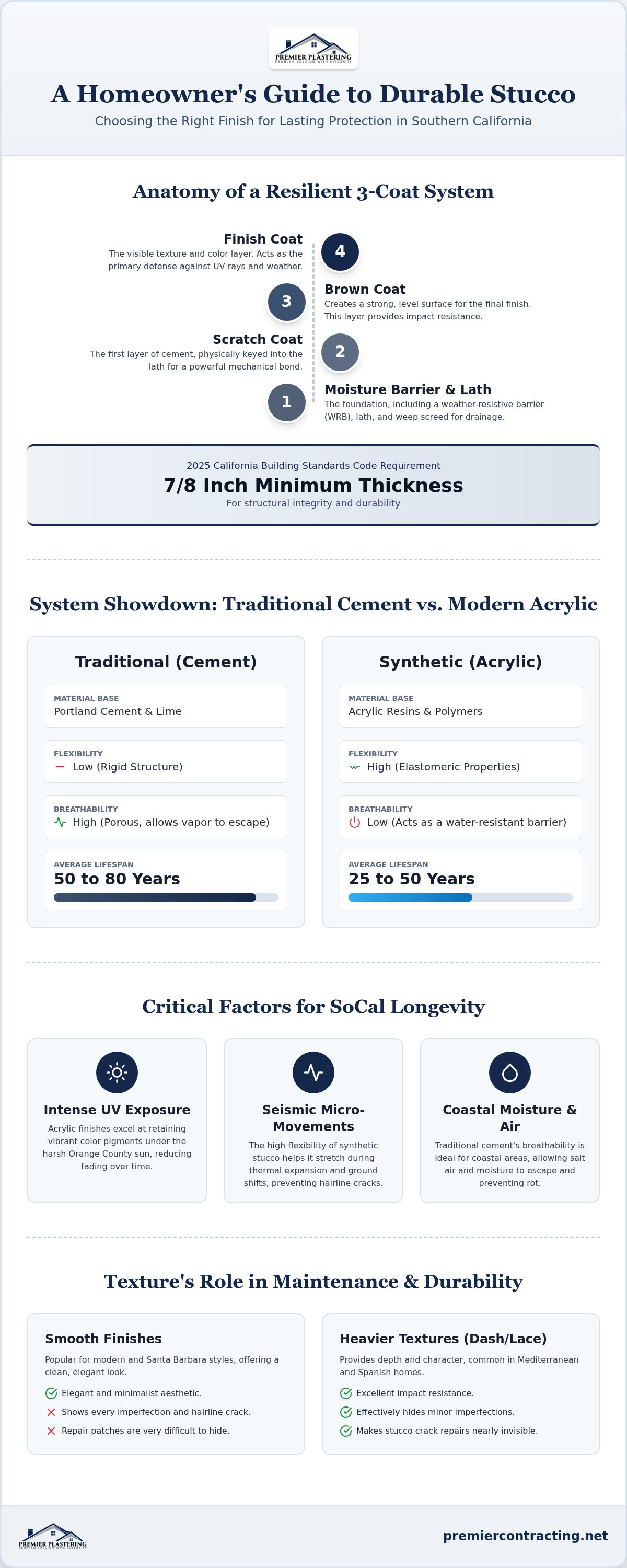
A durable stucco finish isn't just a thick layer of cement. It's a carefully engineered, multi-layered system designed for superior impact resistance and moisture management. If you're researching What is Stucco?, it's best to view it as a structural skin that protects your home's framing. This system relies on the 2025 California Building Standards Code requirement of a 7/8 inch minimum thickness for traditional Portland cement plaster to ensure structural integrity.
The traditional three-coat system provides the foundation for this longevity. First, the scratch coat anchors into the metal lath. Second, the brown coat creates a level, strong surface for the final application. Finally, the color or texture coat is applied. Material compatibility between these layers is the single most important factor in preventing delamination; they must bond chemically to act as one unit. The finish coat acts as the primary defense against harsh UV rays and environmental pollutants.
The Role of the Substrate and Moisture Barrier
Longevity starts long before the first bucket of mud is mixed. The underlying lath and weather-resistive barrier (WRB) determine how well the topcoat performs over twenty years. A critical component is the weep screed, which allows trapped moisture to drain safely away from the house. Without this drainage, water builds up behind the wall, leading to rot and structural failure.
Texture Choice and Impact Resistance
Your choice of texture affects both style and maintenance needs. Smooth finishes, popular in San Diego and Santa Barbara styles, look elegant but show every imperfection. In contrast, heavier textures like Dash or Lace offer better impact resistance against stray baseballs or lawn equipment. The depth of your chosen texture also determines how seamlessly you can perform stucco crack repair if the ground shifts. Heavier textures hide patches much more effectively than smooth surfaces.
Traditional Cement vs. Acrylic Synthetic Finishes
Choosing between traditional and synthetic systems is the most consequential decision you'll make for a durable stucco finish. Traditional stucco remains the gold standard for Southern California’s Mediterranean and Spanish architecture. It's prized for its natural breathability, which allows moisture vapor to escape through the wall assembly safely. This system aligns perfectly with the 2025 California Building Standards Code for structural thickness and fire resistance.
| Feature | Traditional (Cement) | Synthetic (Acrylic) |
|---|---|---|
| Material Base | Portland Cement and Lime | Acrylic Resins and Polymers |
| Flexibility | Low (Rigid structure) | High (Elastomeric properties) |
| Breathability | High (Porous surface) | Low (Water-resistant barrier) |
| Average Lifespan | 50 to 80 Years | 25 to 50 Years |
Synthetic stucco provides high flexibility by utilizing acrylic resins that act as an elastomeric skin. This material helps the surface stretch during thermal expansion rather than snapping under pressure. According to the Stucco Manufacturers Association, these systems excel at maintaining vibrant pigments even under intense Orange County UV exposure.
[Image: Side-by-side photo showing cementitious texture vs. acrylic smooth finish]
Maintenance Requirements for Each Type
Your material choice dictates your long-term stucco maintenance routine. Cement finishes require specialized care to maintain their porous nature, such as fog coating to refresh color without clogging surface pores. Acrylic surfaces are much more stain-resistant and typically only require a gentle power washing to remove Fullerton dust and environmental pollutants.
Cost vs. Longevity Investment
Synthetic finishes often cost more upfront but help you avoid frequent stucco peeling repair costs. Traditional stucco offers a lower initial price point and can last over 50 years with a stable foundation and proper lath protection. If you need help choosing the right system, our team can provide a professional assessment of your home's unique structural needs.
Critical Factors for Longevity in Southern California
UV degradation from the intense Fullerton and Anaheim sun remains the primary threat to exterior longevity. Over time, high radiation levels break down chemical binders, causing the surface to become brittle. This vulnerability, combined with Orange County’s seismic micro-movements, often necessitates professional stucco patching Fullerton residents rely on for structural stability.
Patience during the application phase is the key to a durable stucco finish. The scratch and brown coats must be moist-cured for at least 48 hours to prevent the material from drying too quickly. Proper hydration of the cement during these initial phases is non-negotiable for preventing deep shrinkage cracks.
Moisture Management and the Weep Screed
A blocked or missing weep screed is the leading cause of stucco water damage repair in Southern California. To function correctly, the screed needs a clearance of 4 inches above raw earth and 2 inches above paved surfaces. This gap ensures that moisture trapped behind the wall can escape without damaging the home's framing.
[Image: Diagram of a properly installed weep screed with clearance measurements]
The Importance of Seamless Patching
A seamless stucco repair provides structural continuity that prevents future water intrusion. We utilize a "feathering" technique to taper the edges of the new patch into the existing surface. This creates a unified bond that protects your home while restoring its original beauty. If you notice signs of cracking, schedule a professional inspection to assess your home's exterior health.
Selecting the Right Finish for Your Local Environment
Your local micro-climate is the final factor in engineering a durable stucco finish. Southern California’s diverse geography means a home in the hills faces different stressors than one near the Pacific. Matching your finish to these specific environmental demands is the best way to ensure long-term performance.
- Coastal Areas (Huntington Beach): We recommend high-permeability finishes to prevent salt-air moisture traps. These coatings allow the wall to breathe, which stops the bubbling and delamination common in high-humidity zones.
- Inland Heat (Yorba Linda/Anaheim): Light-reflective pigments are essential here to reduce thermal expansion. Keeping surface temperatures lower prevents the stress-cracking that occurs when dark walls bake in the summer sun.
For homeowners seeking a premium aesthetic, Venetian plastering Fullerton offers a luxury option for high-end accents. While traditionally an interior finish, modern artisanal techniques can adapt these smooth, marble-like surfaces for protected exterior focal points.
Color and Texture Coordination
Choosing the right hue is a practical maintenance decision. Earth tones and mid-range beiges mask Southern California dust and environmental staining better than stark whites. We always advocate for "Integrated Color" systems where the pigment is mixed directly into the finish coat. This approach is superior to painting because it maintains the wall's breathability and ensures the durable stucco finish stays vibrant even if minor surface chips occur.
Hiring a Specialist vs. a Generalist
Hiring a stucco contractor in Fullerton requires checking for specific exterior restoration experience rather than general remodeling skills. Stucco is a specialized trade that demands an understanding of moisture barriers and structural movement. As a family-owned business, Premier Plastering prioritizes personal accountability on every project. We treat your home with the same meticulous care we'd give our own, ensuring your exterior remains a point of pride for decades.
Protecting Your Home’s Exterior for the Decades Ahead
While stucco is a specialized trade, those looking for a similar level of commitment for broader home projects may want to discover Lotz Renovations, Inc., a family-owned remodeling contractor that has been operating since 1986.
Achieving a durable stucco finish requires a blend of high-grade materials and disciplined application. Whether you choose the breathability of traditional cement or the flexibility of an acrylic system, success depends on respecting the curing process and maintaining proper drainage. Your local environment in Orange County dictates the best texture and color choices for long-term resilience and curb appeal.
At Premier Plastering, we bring decades of artisanal stucco expertise to every project. As a family-owned business led by Corey, we take personal pride in delivering structural integrity and aesthetic beauty. We specialize in everything from seamless traditional repairs to luxury Venetian plastering that elevates your home's character. Don't wait for minor hairline cracks to become major structural issues.
Request Your Expert Stucco Evaluation from Premier Plastering today. We look forward to helping you protect your investment with craftsmanship that stands the test of time.
Common Questions About Durable Stucco Finishes
How long does a durable stucco finish typically last in Southern California?
A traditional three-coat system can last between 50 and 80 years in our specific climate. Synthetic systems generally offer a lifespan of 25 to 50 years. Longevity depends heavily on maintaining your weep screed and addressing minor cracks before moisture enters the wall. In cities like Anaheim or Fullerton, the lack of extreme freeze-thaw cycles helps a durable stucco finish reach its maximum service life.
Can I apply a synthetic acrylic finish over my old traditional cement stucco?
You can apply an acrylic finish over traditional cement stucco, but the preparation is critical. The existing surface must be clean, structurally sound, and free of loose debris or old paint. We often apply a specialized base coat to ensure the new material bonds correctly to the old cement. This upgrade provides better flexibility and crack resistance for older homes in Orange County that experience minor shifting.
What is the best stucco texture for hiding hairline cracks?
Heavier textures like Lace, Dash, or Knockdown are the most effective at masking hairline cracks. These deeper patterns break up the visual plane, making minor imperfections nearly invisible to the naked eye. Smooth finishes, while popular in modern Fullerton architecture, tend to highlight even the smallest settlement cracks. Choosing a textured surface reduces the visual urgency of repairs while maintaining your home's curb appeal and structural integrity.
How much does it cost to re-finish a stucco home in Orange County?
Costs for re-finishing vary based on your home's square footage, the number of stories, and the current condition of the substrate. Factors like the choice between traditional cement and synthetic acrylic also influence the final investment. Local permit fees in Fullerton and labor rates for specialized master craftsmen contribute to the total. We recommend a professional evaluation to determine the specific requirements for your property's unique architectural style.
Does a darker stucco color fade faster in the Fullerton sun?
Darker pigments do tend to fade faster under the intense Fullerton sun because they absorb more UV radiation. This thermal absorption also causes the wall to expand and contract more than lighter shades, which can lead to stress cracks. For inland areas like Yorba Linda or Anaheim Hills, we suggest lighter, reflective earth tones. These colors maintain their vibrancy longer and help keep your home's exterior surface temperatures lower. For homeowners in other high-sun regions like the Southwest, working with a specialized contractor like Chaparro's Painting, LLC can ensure that exterior finishes are chosen specifically for their UV resistance and long-term durability.


