

That unsightly flake on your exterior wall is rarely just a cosmetic flaw. It's a distress signal from the layers beneath. When you notice your home's finish starting to bubble or drop away in sheets, it's natural to feel a sense of unease about what is happening behind the surface. You might have already tried a quick fix that didn't hold, leaving you uncertain about the true cost of a lasting solution. We understand that your home is your most significant investment, and seeing its aesthetic decline can be deeply unsettling.
The good news is that a proper stucco peeling repair does more than just hide the damage; it restores the protective envelope of your property. In this article, you'll learn why your stucco is failing and how to implement a permanent, professional-grade fix that brings back your home's original beauty. We will explore the root causes of delamination, from moisture trapped behind the lath to improper bonding. By the end, you'll have a clear roadmap for achieving a seamless, durable finish through the hands of a local craftsman who prioritizes integrity and technical excellence over a fast, temporary patch.
Key Takeaways
- Learn how to use the "Pick Test" to distinguish between simple surface paint failure and more serious stucco delamination.
- Understand the role of efflorescence and moisture in stucco peeling repair to ensure your fix addresses the root cause rather than just the symptoms.
- Identify the hidden structural risks, such as lath corrosion and mold growth, that occur when peeling surfaces are left unaddressed.
- Discover the five-step professional framework for achieving a principled bond and a seamless, durable finish that stands the test of time.
- Recognize why local craftsmanship in Orange County is essential for navigating regional climate factors and delivering a true restoration.
Why Is My Stucco Peeling? Identifying the Root Causes
To address a failing exterior, we have to look past the surface. Stucco peeling is the physical separation of the finish coat or paint from the underlying base layers. It isn't merely an aesthetic blemish. It's a sign that the structural harmony of the wall has been disrupted. To understand why this happens, it helps to revisit the basics of What is Stucco? and how its layered composition relies on a principled bond to remain intact. When that bond fails, the material begins to flake, bubble, or drop away in sheets.
One of the primary culprits is efflorescence. This process occurs when moisture migrates through the porous cement, carrying dissolved mineral salts to the surface. As the water evaporates, these salts crystallize. The resulting pressure is often strong enough to push the finish coat right off the wall. In Orange County, our environment adds unique stressors. High UV exposure in Fullerton and Anaheim can bake the surface, while coastal humidity in Huntington Beach keeps the substrate damp. This constant tug-of-war between heat and moisture accelerates the breakdown of even the most robust finishes.
The Role of Moisture Intrusion
Water is patient. It finds its way behind the stucco through even the smallest hairline cracks. While colder climates worry about freeze-thaw cycles, Southern California homes face intense thermal expansion. The stucco expands in the afternoon heat and contracts in the cool evening air. Over time, this movement widens gaps around windows and doors. Selecting the right sealant for these joints is essential, and technical guides from metroreconstruction.com provide valuable insight into which materials best resist moisture. You might notice "stucco tears," which are dark vertical stains, before the actual peeling begins. These stains are early warnings that water is trapped, slowly dissolving the bond from the inside out.
Poor Surface Preparation from Previous Repairs
Many homeowners find themselves needing a stucco peeling repair because a previous handyman fix lacked technical discipline. If a repair is rushed, paint is often applied over damp or dirty surfaces. This creates a temporary mask rather than a permanent solution, which is why professional teams like The Awesome Painting Services emphasize the importance of proper preparation. Within 12 months, the new layer typically begins to bubble and flake. There is also the issue of chemical incompatibility. Applying modern, non-breathable acrylic paints over traditional lime-based stucco can trap moisture. This leads to a rapid failure of the finish, as the wall can no longer breathe as it was originally designed to do.
Paint Peeling vs. Stucco Delamination: A Diagnostic Guide
Not all peeling is created equal. Before you begin a stucco peeling repair, you must identify whether the failure is skin-deep or structural. A "Pick Test" is your most reliable first tool. Use a small putty knife or even a fingernail to gently lift a loose edge of the peeling material. If only a thin, flexible film of paint comes away, revealing a solid, grey cement surface beneath, you're likely dealing with surface failure. However, if the material is brittle, thick, or brings sandy cement along with it, you've discovered delamination. Visual cues also tell a story. Bubbling often suggests trapped moisture or gas, while flaking usually points to a loss of elasticity in the paint. Crumbling is the most severe sign, indicating that the cementitious bond itself has turned to dust.
Identifying Surface Paint Failure
Surface failure often stems from age or relentless Southern California UV exposure. Low-quality acrylic paints are particularly prone to this. Over time, they become brittle and lose their ability to expand and contract with the wall. This leads to "alligatoring" or flaking. If the underlying stucco is firm and dry, a scrape-and-repaint approach is a viable solution. It's vital to use breathable, elastomeric coatings during this process. These specialized finishes allow moisture vapor to escape from the wall while providing a flexible shield against the elements. If you're unsure about the integrity of your exterior, consulting a specialist in stucco patching and repair can prevent you from wasting money on a temporary fix.
Recognizing Structural Delamination
Delamination is a more serious concern that involves the separation of the stucco layers themselves. This typically happens when the finish coat loses its grip on the brown coat. You'll see chunks of cementitious material falling off rather than just thin paint flakes. A reliable diagnostic method is the "hollow sound" test. Gently tap the affected area with the back of a screwdriver. A sharp "click" means the bond is solid. A dull "thud" or a hollow echo indicates an air pocket where the layers have separated. Adhering to Industry Standards for Stucco is critical during these repairs. Localized peeling often hints at a systemic failure. Addressing the surface without fixing the substrate is a wasted investment. It's like painting over a rusted car; the rot continues underneath until the entire system fails.
The Hidden Dangers of Ignoring Peeling Stucco
It is tempting to view a small patch of flaking material as a minor cosmetic annoyance. The reality is far more urgent. Stucco is your home's primary defense against the elements. When that defense breaches, the deterioration of the underlying structure begins immediately. In competitive real estate markets like Villa Park or Anaheim Hills, curb appeal is paramount. A home with visible exterior failure sends a signal to buyers that the property hasn't been properly maintained, potentially slashing its market value. It suggests hidden problems that a savvy inspector will surely uncover.
Delaying a stucco peeling repair also leads to an exponential increase in restoration costs. What starts as a localized patch job can quickly evolve into a full-scale re-stucco project if the damage spreads to the substrate. It's a matter of technical stewardship; addressing the issue early protects your investment and your peace of mind. At Premier Plastering, we've seen many instances where a simple fix was ignored until it became a structural crisis. Doing the right thing early is always more cost-effective than waiting for a total system failure.
Moisture and the Metal Lath
When the finish coat peels away, it exposes the galvanized metal lath to the air. In coastal cities like Huntington, the salt-laden air is particularly aggressive. It accelerates the oxidation of the metal. As the lath rusts, it undergoes "rust expansion." The metal literally swells as it corrodes. This internal pressure pushes against the remaining stucco, causing even more of the finish to pop off in a destructive cycle. Once the lath's structural integrity is gone, the entire wall system is compromised and requires much more than a surface-level fix.
Compromising the Building Envelope
Behind the lath lies the building's weather-resistive barrier, often Grade-D builder's paper. This material is designed to shed water, but it isn't meant for direct UV exposure. Peeling stucco allows sunlight and wind to degrade this barrier. Once the paper fails, water reaches the shear walls and studs. This moisture leads to wood rot, which can undermine the house's skeletal strength. Even worse, damp wall cavities are the perfect breeding ground for mold and mildew. These hidden health hazards can persist for years before they're discovered, turning a simple exterior fix into a complex environmental remediation project. Protecting the building envelope is the most important duty of a principled craftsman.
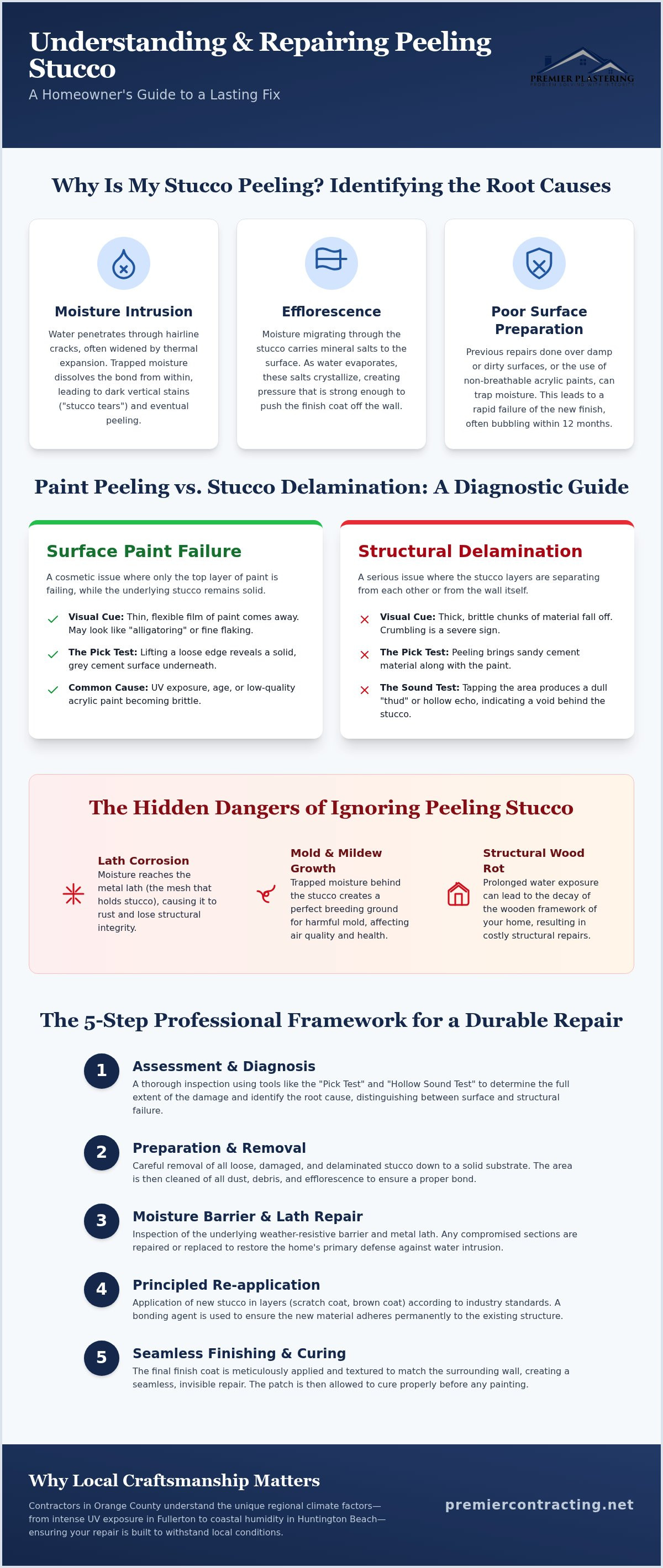
The 5-Step Professional Framework for Stucco Peeling Repair
A lasting repair isn't about speed; it's about discipline. When we approach a stucco peeling repair, we follow a structured framework that ensures the new material becomes a permanent part of your home's history. This methodical process prevents the recurrence of failure by addressing the structural bond from the inside out. We treat every wall as if it were our own, applying a level of technical stewardship that goes beyond simple patching.
- Step 1: Removal. We meticulously clear away every loose flake and compromised section. If we leave a single weak area, the entire repair is destined to fail.
- Step 2: Preparation. The substrate is scrubbed and neutralized. A clean surface is the only way to achieve a principled bond.
- Step 3: Bonding. We apply professional-grade bonding agents and base coats that bridge the old material with the new.
- Step 4: Texture Matching. This is the artisanal phase where the repair becomes invisible.
- Step 5: Curing and Finishing. We allow the cement to reach its full strength before applying a breathable, high-quality finish.
If your home is showing signs of distress, don't settle for a temporary mask. Our team provides the expert stucco services required to restore your exterior with integrity and precision.
Achieving a Seamless Texture Match
Matching common Southern California finishes like Lace, Sand, Dash, or Scraped is where craftsmanship truly shines. A master craftsman understands that a home built in the 1920s requires a different set of floats and techniques than a modern residence. We use specific wood or sponge floats to replicate the original hand of the plasterer. By using a "feathering" technique, we blend the new edges into the existing wall, effectively hiding the repair line from the naked eye. This attention to detail ensures that the restoration is felt through durability but never seen through the finish.
Advanced Bonding and Material Selection
Integrity in repair starts with the chemistry of the materials. We utilize specific Portland cement mixes tailored for the unique requirements of Fullerton and Anaheim residences. To enhance flexibility and adhesion, we incorporate acrylic modifiers into our modern stucco patches. These additives allow the material to better withstand the thermal expansion common in our climate. Before any final decorative finish is applied, we verify the pH balance of the new patch. This technical step prevents "hot spots" from burning through the paint, ensuring the color remains consistent and the bond remains unbreakable for decades to come.
Choosing a Principled Contractor in Orange County
Finding the right partner for your home's exterior is a decision that affects your property's health for decades. In Orange County, where the sun is relentless and the coastal air carries salt, a generic approach won't suffice. You need a craftsman who understands the specific architectural nuances of Fullerton and Anaheim. Whether your home is a classic Spanish Colonial or a mid-century build, the repair must respect the original design and materials. A principled contractor doesn't just look at the surface; they look at the history and the environment of the structure.
There is a profound difference between a quick "patch job" and a professional restoration. A patch job is often a temporary mask that hides the problem until the next rainy season. A restoration is a technical revival that addresses the root cause of the failure. When you vet candidates for your stucco peeling repair, you should ask detailed questions to ensure they prioritize longevity:
- How will you ensure the new texture matches the existing hand-applied finish?
- What steps are taken to inspect and repair the underlying moisture barrier?
- Do you use specific bonding agents tailored to the age of my home's stucco?
- How do you handle the transition between the old material and the new to prevent future cracking?
The Value of Ethical Craftsmanship
We believe in doing the right thing even when no one is watching. This philosophy is the foundation of every project we undertake. It means taking the extra time to ensure the substrate is perfectly clean and the pH balance is verified before any finish is applied. These invisible steps are what lead to 20-year repairs rather than 12-month failures. Our team, led by Corey, approaches every repair as a personal endeavor. We maintain a clean, disciplined job site and treat your property with the respect it deserves. We aren't just providing a service; we're acting as stewards of your home's integrity.
Service Areas and Local Commitment
As a family-owned business, our reputation is built on the trust of our neighbors. We proudly serve Fullerton, Orange, Anaheim, and the surrounding coastal cities. Because we live and work in this climate, we understand the unique pressures our local architecture faces. We don't rely on high-pressure sales or detached corporate language. Instead, we offer transparent, expert guidance rooted in decades of specialized experience. If you are ready to move past temporary fixes and invest in a lasting solution, Contact Premier Plastering for a meticulous stucco evaluation. We look forward to restoring the beauty and safety of your home.
Restoring the Integrity of Your Home's Exterior
Addressing a stucco peeling repair is about more than just aesthetics; it's an act of stewardship for your property. We have explored how to distinguish between simple paint failure and the deeper structural risks of delamination. By following a disciplined, five-step framework, you can ensure that your home remains protected against the unique environmental stressors of Orange County. A principled repair doesn't just mask the damage; it restores the building envelope and prevents future moisture intrusion from compromising your home's skeletal strength.
As a family-owned and operated team based in Fullerton, we take immense pride in our quiet dedication to workmanship. We specialize in seamless texture matching and offer expert knowledge in both traditional stucco and high-end Venetian finishes. We believe in doing the right thing for your home, ensuring every layer is applied with technical meticulousness. If you're ready to secure your home's future with a lasting restoration, we're here to guide you through the process with transparency and respect.
Schedule Your Professional Stucco Repair Consultation with Premier Plastering and take the first step toward a beautiful, durable exterior that stands the test of time.
Frequently Asked Questions
Can I just paint over peeling stucco to save money?
Painting over loose material is a temporary mask that often leads to more expensive failures later. The new paint cannot bond to a surface that is already flaking away, so the entire layer will likely peel within a year. A principled approach requires removing all compromised material and addressing the underlying moisture source before applying a fresh finish coat. Doing it right the first time protects your long-term investment.
How much does professional stucco peeling repair cost in Orange County?
The investment required for a stucco peeling repair depends on the depth of the damage and the complexity of your home's specific texture. While small patches are less intensive, repairs involving moisture remediation or structural delamination require more time and specialized materials. We recommend a meticulous on-site evaluation to determine the exact scope of work needed to restore your exterior's integrity and aesthetic beauty.
Why is my stucco bubbling or blistering after a rainstorm?
Bubbling is a clear sign that water has breached the exterior and is trapped behind a non-breathable finish. When the Southern California sun warms the wall after a storm, that trapped moisture turns into vapor and expands. This pressure forces the paint or finish coat to pull away from the cement. It indicates that your building envelope is no longer shedding water effectively and needs professional attention.
How long should a professional stucco patch last?
A repair executed with technical discipline and high-quality bonding agents should last 20 years or more. Longevity isn't just about the patch itself; it's about addressing the root cause like efflorescence or improper drainage. When we restore a surface, we focus on creating a permanent bond that breathes with your home. This ensures the repair withstands the thermal expansion common in our Fullerton and Anaheim climate.
What is the best time of year to repair stucco in Southern California?
Our mild climate allows for successful repairs year-round, though the dry months of spring and fall offer the most stable curing conditions. Consistent, moderate temperatures help the cementitious layers reach their full structural strength without drying too quickly. We monitor local weather closely to avoid application during heavy rain, ensuring the substrate remains dry and ready for a principled bond that stands the test of time.
Is peeling stucco a sign of a structural problem with my house?
It can be a precursor to serious issues if the failure goes deeper than the surface paint. If the cement itself is crumbling or sounds hollow when tapped, the stucco may be delaminating from the metal lath or wooden framing. This allows moisture to reach the skeletal studs of your home, potentially leading to wood rot. Addressing these signs early prevents a cosmetic flaw from turning into a structural crisis.
Can you match the texture of my 30-year-old stucco?
Achieving a seamless match is an artisanal secret that requires a master's touch and the right toolset. We use specific wood and sponge floats to replicate the original hand-applied finish of your home, whether it's a heavy lace or a fine sand texture. Our goal is to blend the edges so perfectly that the repair line is invisible. We take great pride in making sure the restoration honors your home's history.
What is efflorescence, and why is it making my stucco flake off?
Efflorescence is a crystalline deposit of salts that forms when moisture migrates through the porous stucco. As the water evaporates at the surface, these salt crystals grow and exert tremendous pressure behind the finish coat. This physical force is what causes the material to flake and drop away. A successful stucco peeling repair must include neutralizing these mineral deposits to ensure the new bond remains secure and salt-free.


