

The rock-hard exterior of a traditional home might actually be more fragile than you think when the ground starts to shake. Deciding between synthetic stucco vs traditional stucco involves more than just picking a texture. You're choosing how your property breathes, moves, and defends itself. Traditional three-coat cement offers a timeless mineral aesthetic that thrives in our dry heat. Meanwhile, modern acrylic systems provide the elastic tension needed to resist the hairline cracks that often frustrate Southern California homeowners.
It's natural to feel protective of your home's integrity while worrying about moisture trapping or maintenance costs. We believe you deserve an honest look at which system truly serves your needs. This guide promises to simplify the technical jargon so you can make a confident decision. We'll explore the critical differences in durability, curb appeal, and energy efficiency for 2026.
Our comparison examines the moisture-drainage requirements of synthetic EIFS and the fire-resistant virtues of classic cement. You'll also discover how each option aligns with the latest Title 24 energy standards to keep your home comfortable and compliant.
Key Takeaways
- Compare the multi-layer composition of Portland cement systems against modern acrylic-based EIFS to see which fits your home's structure.
- Evaluate how specific R-values and continuous insulation help your exterior meet the latest California Title 24 energy standards.
- Discover the specific maintenance requirements for each system, from simple patching techniques to complex full-wall refinishing.
- Use our master craftsman criteria to decide between synthetic stucco vs traditional stucco for your specific Southern California neighborhood.
Defining the Systems: Traditional Cement vs. Synthetic Stucco (EIFS)
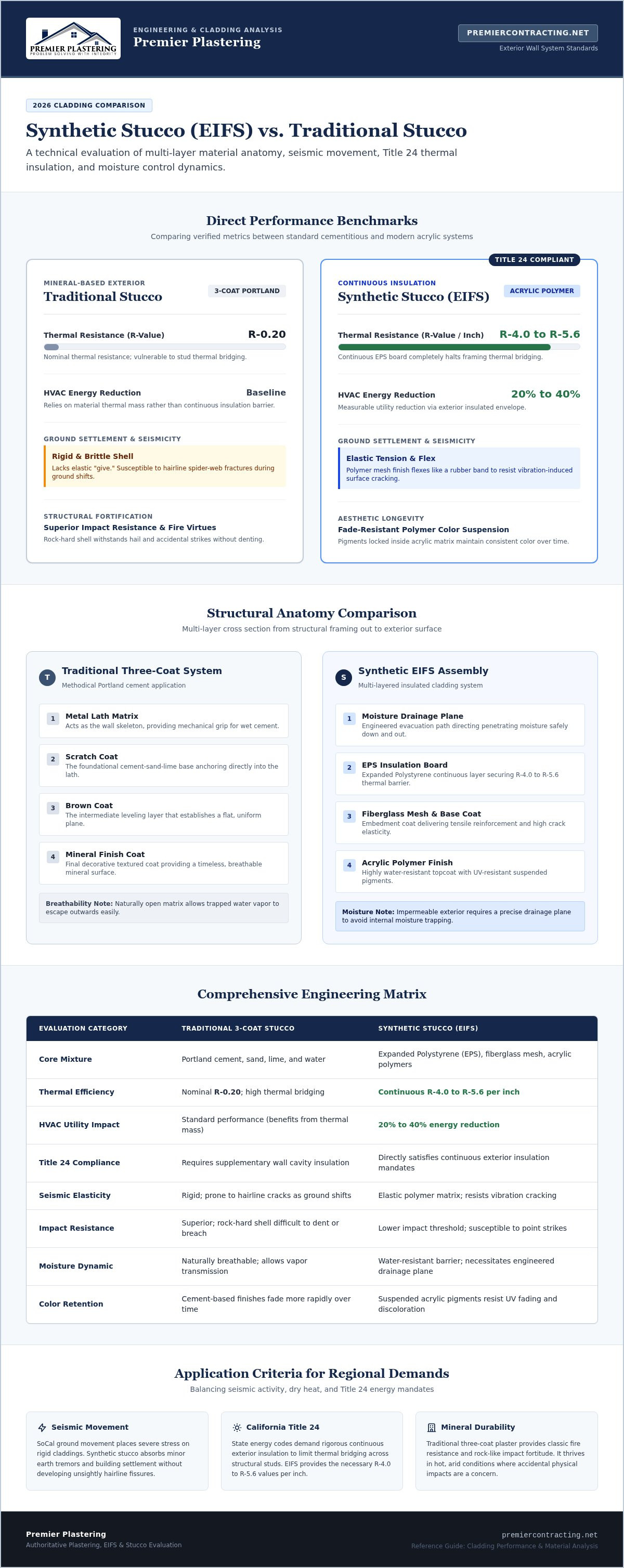
Traditional stucco relies on a classic mixture of Portland cement, sand, lime, and water. It's a heavy, rock-like shell that has protected homes for centuries. In contrast, Exterior Insulation and Finish Systems (EIFS), or synthetic stucco, is a multi-layered cladding system that provides both a finished surface and insulation in one step. While traditional systems are naturally breathable and allow water vapor to escape, synthetic systems are highly water-resistant and require a precise drainage plane to prevent moisture buildup. Choosing synthetic stucco vs traditional stucco often comes down to balancing this breathability against modern thermal needs.
The Layers of Traditional Stucco
The strength of traditional stucco comes from its methodical three-coat application. First, we install a metal lath to provide a structural grip for the wet material. This lath acts as the skeleton of the wall. We then apply the layers in this specific sequence:
- Scratch Coat: The base layer that anchors directly to the lath.
- Brown Coat: The leveling layer that creates a flat, uniform surface.
- Finish Coat: The final decorative layer that provides the texture.
This process creates a rigid shell that is exceptionally impact-resistant. It's a proven method for homeowners who value a time-tested, mineral-based exterior.
The Anatomy of a Synthetic System
When comparing synthetic stucco vs traditional stucco, the internal structure is where they differ most. A synthetic system starts with an Expanded Polystyrene (EPS) insulation board attached to the exterior. We then apply a base coat reinforced with fiberglass mesh to give the wall flexibility. Finally, an acrylic finish coat is applied. This top layer offers superior color consistency over time because the pigments are suspended in a flexible polymer. It doesn't fade as quickly as cement-based finishes, ensuring your home looks freshly plastered for years.
Performance Breakdown: Durability, Flexibility, and Energy Efficiency
Performance is where the technical differences of synthetic stucco vs traditional stucco become tangible for homeowners. Traditional cement stucco acts as a heavy fortress, offering superior impact resistance against hail or accidental strikes. Its rock-hard surface is difficult to dent, making it ideal for high-traffic areas. However, this rigidity becomes a liability in Southern California's active seismic environment. Because cement is brittle, it lacks the "give" needed to handle ground shifts without fracturing.
Seismic Flexibility and Cracking
Traditional stucco is prone to hairline cracks as a building settles or the earth moves. These spider-web patterns aren't just an eyesore; they can allow moisture to seep into your wall assembly. If you've noticed these fractures on your property, our guide to stucco crack repair provides professional steps for restoration. Synthetic systems use acrylic polymers and fiberglass mesh that allow the finish to flex like a rubber band. Building Science Corporation's analysis of EIFS and stucco highlights how this elasticity prevents surface cracking during minor vibrations.
Thermal Performance and Energy Savings
Achieving a high R-value is essential for reducing energy costs and maintaining indoor comfort. For those looking to understand how professional insulation impacts a building's thermal envelope, Third Coast Spray Foam offers a comprehensive look at high-performance solutions that complement modern exterior systems.
Energy efficiency is a major differentiator for modern homeowners. Synthetic EIFS incorporates continuous insulation boards that provide an R-value between R-4.0 and R-5.6 per inch. This layer stops "thermal bridging," which is the heat transfer that occurs through your wall studs. Traditional stucco has a nominal R-value of only 0.20, offering almost no thermal resistance. While cement has great thermal mass, it can't match the 20% to 40% HVAC energy reduction that synthetic systems deliver. If you're looking to lower your utility bills, our expert stucco services can help you integrate these energy-saving layers into your home's exterior.
Maintenance and Repair: What Homeowners Should Expect
Maintaining your home's exterior requires a clear understanding of how different materials age and respond to fixes. When comparing synthetic stucco vs traditional stucco, the ease of future repairs is a primary concern for long term costs. Texture matching stands as the most critical step in seamless stucco repair, ensuring that new patches blend perfectly with the original finish. If the texture is off by even a fraction, the repair will stand out every time the sun hits the wall.
Traditional cement systems are significantly easier to patch because the new material bonds chemically with the existing substrate. In contrast, synthetic systems often require "re-lamping" or a full-wall coating to ensure a seamless finish after a repair. Acrylic finishes are difficult to feather out. This often means we must recoat the entire architectural section to hide the patch and avoid a visible "halo" effect.
The Ease of Traditional Patching
Cement-based patches are forgiving for a skilled hand. They bond mechanically and chemically with the layers beneath them, allowing for localized fixes that disappear once painted. You should check for signs your stucco needs repair early to prevent minor cracks from becoming structural issues. Catching a hairline fracture now saves you from a full-scale restoration later.
Synthetic Stucco and the Moisture Trap Risk
Moisture management is the top priority for any synthetic system. While modern "drainable" EIFS has solved many historical rot issues, the system still relies on perfect seals. Building Science Corporation's analysis of EIFS and traditional stucco performance notes that moisture trapped behind non-breathable synthetic layers can lead to substrate rot. You must maintain precise caulking around every window, door, and light fixture to keep the system watertight. If you suspect your seals are failing, contact us for professional stucco patching and repair to protect your home's framework.
Choosing the Right System for Your Southern California Property
Newer constructions or energy-focused retrofits are prime candidates for synthetic EIFS. If your goal is to maximize thermal resistance and achieve a modern, uniform look, the acrylic system is the superior choice. It allows for vibrant, lasting colors that won't fade under the intense Southern California sun. You get a seamless finish that boosts curb appeal while significantly lowering your monthly utility bills. For homeowners researching high-quality facade materials and modern exterior finishes, pauresta.lt offers a look at contemporary options that enhance both style and protection.
The Decision Matrix: Budget vs. Performance
When weighing synthetic stucco vs traditional stucco, consider both upfront costs and long-term value. Traditional three-coat systems usually require more intensive labor, which can drive up the initial price. However, the raw materials like sand and cement are relatively inexpensive. Synthetic systems reverse this dynamic by using proprietary, high-cost polymers that offer better flexibility and insulation.
Long-term energy savings often tip the scale toward synthetic options for modern homeowners. These systems pay for themselves over time by reducing the load on your HVAC system. We recommend evaluating your home's specific sun exposure and local microclimate before committing to a material.
Consulting a Master Plasterer
Every property has unique needs that a generic guide can't fully address. A local expert like Corey at Premier Plastering provides the site-specific evaluation necessary to ensure a lasting result. We take pride in helping you choose a system that respects both your budget and your home's architectural integrity. Before you hire any professional, review our stucco contractor Fullerton checklist to ensure they meet the highest standards of craftsmanship.
Protecting Your Home's Legacy
Choosing between synthetic stucco vs traditional stucco is a significant step in securing your property's long-term value. Traditional cement systems offer a breathable, impact-resistant shield that suits historic architecture, while synthetic EIFS provides the energy efficiency and seismic flexibility modern homeowners demand. Both options require a master craftsman's touch to ensure the drainage and finish remain perfect for years.
Premier Plastering brings family-owned integrity and 5-star craftsmanship to every project across Fullerton and Orange County. We specialize in both EIFS and traditional three-coat systems, ensuring your repair or renovation meets the highest artisanal standards. We'll treat your home with the same meticulous care we'd give our own.
Schedule your professional stucco evaluation with Premier Plastering today to get a site-specific recommendation. We're ready to help you choose the best protection for your Southern California home.
Frequently Asked Questions
Is synthetic stucco more expensive than traditional stucco?
Synthetic stucco typically costs more upfront due to the specialized polymer materials and multi-layer installation requirements. While traditional cement uses cheaper raw materials, the labor-intensive three-coat process is also a major factor. Homeowners in Fullerton often find that the initial investment in a synthetic system is offset by lower cooling costs. It's a balance between higher material prices and long-term energy efficiency for your Orange County property.
Can I put synthetic stucco over traditional stucco?
We can definitely apply a synthetic finish over a traditional cement base in a process called a re-skim. This is a popular choice for Anaheim homeowners who want the crack resistance of acrylic without a full demolition. We first inspect the existing wall for structural integrity and patch any deep damage. This hybrid approach gives you the durability of cement with the vibrant, lasting color of a synthetic system.
Does synthetic stucco still have moisture problems?
Modern designs have solved the moisture issues that plagued early barrier systems. Today, we install synthetic stucco vs traditional stucco using a dedicated drainage plane and water-resistive barrier. This allows any incidental moisture to escape harmlessly through the bottom of the wall. As long as we maintain professional seals around your windows and doors, a modern synthetic system is a safe and highly effective choice for Southern California homes.
How do I tell if my house has synthetic or traditional stucco?
You can identify your system with a simple knock test on the exterior wall. Traditional cement stucco is rock-hard and sounds solid when you tap it; it also feels cold like stone. Synthetic stucco usually sounds hollow because of the rigid foam insulation board located behind the acrylic finish. If you notice a slight give when you press on the surface, your house likely has a synthetic system installed.
Which stucco type lasts longer in Southern California?
Both materials offer incredible longevity when installed by a master craftsman. Traditional stucco is a heavy-duty fortress against physical damage but can develop cracks during local seismic shifts. Synthetic systems are much more flexible and resist those spider-web cracks, yet they rely heavily on perfect caulking to stay watertight. Whether you are in Yorba Linda or Santa Ana, regular maintenance is the real secret to making either system last a lifetime.


